Long-term internal communication is much more than a corporate strategy—it’s a way to strengthen the connection with the people who make an organization’s purpose possible. In a world of rapid transformation, recurring crises, and shifting models, companies need a solid long-term vision more than ever.
However, it’s not enough to define that vision—it must be communicated.
Why long-term internal communication is key in complex contexts
A recent academic study by Jurnal Fokus Manajemen reveals that in times of uncertainty or transformation, people seek clarity, empathy, and consistency. Well-managed long-term internal communication has a significant and positive impact on how employees accept change.
When the organization communicates with transparency and active listening:
- Uncertainty decreases, because everyone knows where things are headed and why
- Trust increases, as people feel involved in decision-making
- Bonds are strengthened across departments, teams, and leaders
- Agility improves, as there is a shared framework for action
On the other hand, a study by the global insurance broker Arthur J. Gallagher & Co. indicates that 60% of companies lack a long-term internal communication strategy.
This gap has a cost: lost productivity, lower engagement, and difficulty executing strategies in dynamic environments. And in times of change, this can become even more critical.

Why communicate the long-term vision of your company?
Talking about the future isn’t just a planning practice—it’s a way to inspire and mobilize.
When people understand the direction and purpose, they work with more clarity and commitment.
Communicating the long term matters:
- Because it gives meaning. When employees understand not only what they need to do but also why, they act with greater autonomy.
Because it creates consistency. When messages from headquarters are adapted to each region or department, local contradictions and misunderstandings are avoided.
Because it builds resilience. Even if the environment changes, a stable objective helps drive faster, more aligned, and strategic decisions.
A study from the University of Catalunya confirms that managing internal communication is directly linked to organizational performance: companies with better communication practices report greater innovation, higher productivity, and better strategic alignment.
Current challenges for global companies
Today, companies face major challenges. Understanding these in depth is key to building strategic internal communication and a narrative aligned with corporate purpose.
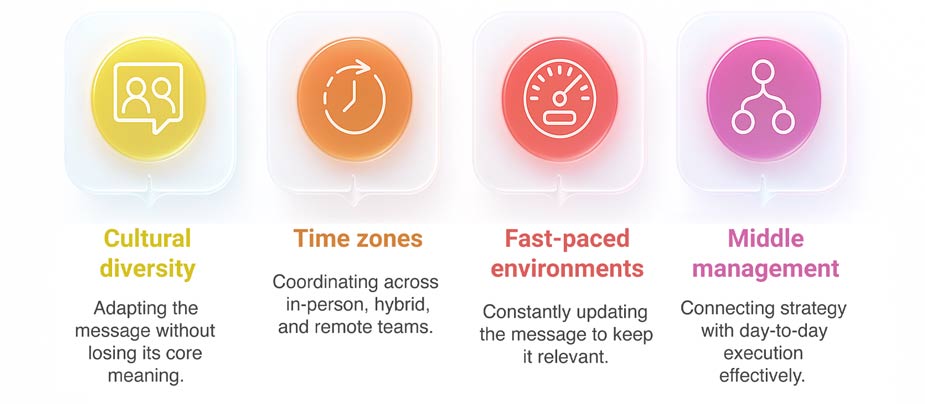
Some of the most common challenges include:
Cultural and language diversity: adapting without losing the core message
Different time zones and work models: coordinating across in-person, hybrid, and remote teams
Fast-paced environments: constantly updating the message to keep it relevant
Role of middle management: connecting strategy with day-to-day execution
What are good internal communication practices?
There are proven institutional practices that help communicate a company’s long-term vision effectively:
Define achievable goals and milestones
Set a clear long-term framework (3–5 years or more) that links the company’s mission, vision, and values with specific milestones.
Develop an internal communication plan
Start with a diagnostic, and define communication channels, frequency, local adaptations, and an audience map.
Use simple, relevant language for each group
According to the digital platform HR Brew, people who receive weekly or daily updates have much greater clarity about corporate goals.
Measure impact
Track alignment, engagement, and understanding through KPIs; conduct internal communication audits.
Create feedback loops
Employees need to feel heard. This two-way communication builds trust and improves execution.
Adapt without losing direction
Long-term vision doesn’t mean rigidity. It means having a framework that guides decisions, even when tactics change.
Purposeful communication: the long-term compass
When the organization’s direction is communicated clearly, consistently, and continuously, it becomes the compass that guides every team and region, every day. In a world of constant change, that compass is what makes the difference between drifting and moving forward with purpose.
At Oxean Cross, as a corporate communication agency focused on both internal and external communication, we help companies develop internal communication strategies that strengthen their purpose, connect their teams, and promote sustainable cultures.
If you want to communicate with more clarity, empathy, and long-term vision, let’s schedule a conversation.
Frequently Asked Questions about Long-term Internal Communication
Why is a long-term internal communication strategy important?
Because it helps sustain the organization’s purpose beyond temporary changes. A consistently communicated vision guides decisions, builds trust, and strengthens corporate identity.
What are the main benefits of communicating a long-term vision?
It gives meaning to daily work, boosts autonomy, and reinforces coherence between teams. When everyone understands where the company is heading, motivation and alignment naturally increase.
What are the main challenges in maintaining long-term communication?
Cultural diversity, time zone differences, hybrid work rhythms, and the speed of change. Overcoming these challenges requires clear planning, adaptable messaging, and well-coordinated channels.
What is the role of middle managers in long-term communication?
They serve as a bridge between strategy and execution. Middle managers translate global messages into local action, ensuring coherence and reinforcing the company’s culture.
How can organizations measure the impact of long-term internal communication?
Through alignment, engagement, and understanding metrics. Periodic communication audits and perception surveys reveal whether messages truly connect with employees.
How can global and multicultural organizations maintain message consistency?
By adapting content while preserving purpose. Creating tone and language guidelines ensures unified standards that still allow local flexibility and respect for diversity.
What role does internal communication play in organizational resilience?
A clear, sustained message acts as an anchor during change. It helps people stay focused, trust the company’s direction, and adapt without losing their sense of belonging.