
What is vertical and horizontal communication in a company?
Vertical and horizontal internal communication defines how information flows within an organization and, as a result, shapes its corporate culture. The balance between these two flows is the fabric that sustains organizational life: it connects departments, aligns goals, and, when done well, accelerates internal transformation.
In an increasingly complex business environment, understanding how vertical and horizontal communication works is just as important as having a strong business strategy.
How does internal communication work within organizations?
The flow that sustains corporate culture
You can’t always see it, but you can feel it. Internal communication is the invisible thread that holds the organization together: it connects teams, aligns goals, and accelerates transformation when it works properly.
Especially in today’s corporate settings, where complexity keeps growing, understanding how information flows has become as essential as outlining a business strategy.
In this ecosystem, there are two main routes:
- Vertical communication, which flows up and down the hierarchical structure
- Horizontal communication, which connects teams and departments at the same level
Both are essential for building agile, collaborative, and consistent workplace cultures.
What is vertical internal communication?
Vertical communication connects the top of the organization with its operational base. It’s the channel through which decisions turn into action and vision becomes concrete tasks.
A clear and consistent change story can significantly increase the chances of a successful transformation.
Key traits of vertical internal communication
- It follows a defined hierarchical direction: it can be downward (from leadership to teams) or upward (from employees to leadership)
- Its tone is institutional, empathetic, and easy to understand
- It plays a strategic role by providing clarity, direction, and purpose
- Middle managers are key players: they translate and ensure the consistency of the messages
When does vertical communication take center stage?
Effective vertical communication becomes crucial when:
- Structural changes are announced
- New global projects are launched
- A corporate message needs to reach all levels with precision
In these moments, solid vertical communication reduces uncertainty, builds trust, and prevents misinformation.
What is horizontal internal communication?
Horizontal internal communication takes place between employees or teams at the same hierarchical level. It’s where day-to-day collaboration, trust, and shared problem-solving are built.
A key element in the era of hybrid work
Since the pandemic and the rise of hybrid work, its relevance has grown exponentially—especially for global companies with distributed offices.
A 2024 study published by MDPI highlights that
effective horizontal communication is now one of the top factors driving cohesion and productivity in distributed environments.
Horizontal communication not only improves coordination across teams but also boosts innovation. When ideas can flow freely, new solutions emerge.
Most common channels for horizontal communication
Among the most used channels are:
- Corporate chat platforms like Teams or Slack
- Internal communities
- Cross-functional projects
- Digital coworking spaces
Another MDPI study found that horizontal communication increases motivation and job satisfaction, serving as a bridge between engagement and talent retention.
In short, horizontal communication isn’t just a way of working—it’s a genuine driver of organizational well-being.
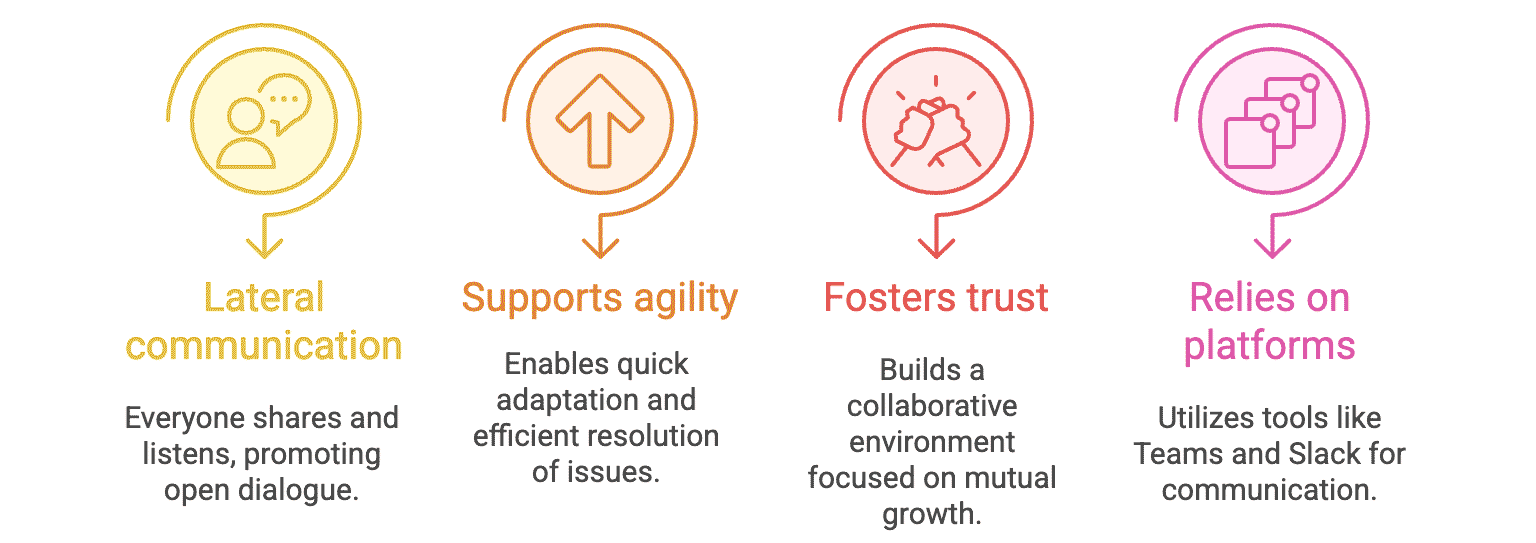
Key characteristics of horizontal communication
Distinctive elements
It’s lateral and two-way: everyone shares, everyone listens
It supports agility and fast problem-solving
It fosters a culture of trust and shared learning
It commonly relies on platforms like Teams, Slack, Google Workspace, or Viva Engage
Where should horizontal communication be used?
Horizontal communication is especially important in innovation, product development, or interdepartmental projects, where the focus isn’t on hierarchy but on the ability to collaborate and co-create.
While vertical communication aligns, horizontal communication connects.
What role do leaders play in integrating vertical and horizontal communication?
Stronger companies are those that manage to integrate both communication flows within a cohesive strategy.
Downward communication provides direction and meaning
Horizontal communication brings vitality, creativity, and a sense of belonging
Distinctive elements
Leaders play an essential role in maintaining that balance. According to a 2024 report by Akademische Gesellschaft für Unternehmensführung & Kommunikation,
74% of internal communication departments in large European companies say their biggest challenge today is integrating both flows (vertical and horizontal) under a shared strategy that connects people and purpose.
A representative example is Microsoft, which in recent years has redefined its employee experience for the hybrid world by blending executive communication with internal collaboration practices and tools like Viva Engage to boost operational transparency and engagement.
How to achieve effective internal communication
Effective internal communication goes beyond simply informing—it builds culture.
It fosters transparency, participation, and alignment with company values. When people understand the “why” and the “what for” behind decisions—and feel their voices are heard—trust grows, and the sense of community strengthens.
Balancing the flows
The challenge is maintaining balance:
Ensuring vertical communication doesn’t become top-down imposition
Avoiding horizontal communication from turning into unstructured noise
The key lies in designing an integrated communication architecture with proper diagnostics, strategic planning, and ongoing evaluation.
Diagnosis, planning, and support: the path to solid communication
Companies that invest in diagnosing, planning, and supporting the evolution of their internal channels achieve:
- Greater organizational cohesion
- More adaptive and human-centered cultures
- Sustainable business results
Want to strengthen vertical and horizontal internal communication in your company?
At Oxean, a corporate communication agency focused on internal and external strategies, we help build meaningful connections from the inside out.
Get in touch with us! Because every transformation starts with a good conversation.
Frequently Asked Questions about Vertical and Horizontal Internal Communication
What is the difference between vertical and horizontal communication in a company?
Vertical communication connects hierarchical levels; horizontal communication links teams at the same level. Both are essential to sustain an agile, cohesive organizational culture.
Why is vertical communication fundamental for leadership?
Because it translates corporate vision into concrete actions. At Oxean, we see that clear top-down and bottom-up flows build trust, give meaning to daily work, and prevent misunderstandings across levels.
When does vertical communication become most critical?
During structural changes, global launches, or company-wide announcements. In those moments, effective vertical communication ensures precise, consistent messaging to every team.
What benefits does horizontal communication bring to corporate culture?
It fosters collaboration, trust, and fast problem-solving. It also fuels innovation and strengthens belonging among areas that work toward shared goals.
Which channels best strengthen horizontal communication?
Corporate chats, internal communities, collaborative platforms like Teams or Slack, and cross-functional projects that enable continuous cooperation.
What role do leaders play in integrating vertical and horizontal communication?
Leaders balance both flows. From Oxean’s perspective, their mission is to connect strategy with collaboration—guiding, inspiring, and promoting ongoing dialogue across levels and teams.
How can organizations balance vertical and horizontal communication effectively?
Through diagnosis, strategic planning, and continuous evaluation. At Oxean, we recommend an integrated communication architecture that promotes transparency, coherence, and active participation.