
Internal communication and organizational change are strategic pillars for any company aiming to evolve in a constantly shifting environment.
The pace at which organizations operate today requires rethinking not just what needs to change, but how to make that change happen. And in that “how,” internal communication becomes a decisive factor.
How poor communication impacts change management
When an organization fails to communicate its transformations effectively, the consequences can be costly.
According to Gartner, only 32% of leaders believe that recent changes in their company were successfully adopted.
Why does this happen?
The most common causes are not technical or financial—they are people-related.
The most cited reasons, according to the Change Management Toolkit from the University of California, Berkeley, include:
- Lack of clear and continuous communication
- Low employee involvement
- Invisible or disengaged leadership
- Inconsistent or unclear messaging
Ineffective communication can stall key transformations and result in millions lost in productivity and engagement.
What is change management, really?
Change management is a structured approach designed to help companies transition from their current state to a desired future state.
But it’s not just about processes—it’s about people and culture. It means preparing, supporting, and equipping employees to adapt to new circumstances and minimize resistance.
This must be paired with a communication plan that outlines how changes will be shared strategically across all departments.
How does internal communication contribute to change management?
Internal communication acts as a bridge between strategy and people. When it is integrated from the beginning of a change project, its impact is multiplied.
That’s why, before launching any change initiative, we recommend conducting an internal communication audit. This helps understand the audience and identify both strengths and areas for improvement—allowing the communication strategy to align with the change process.
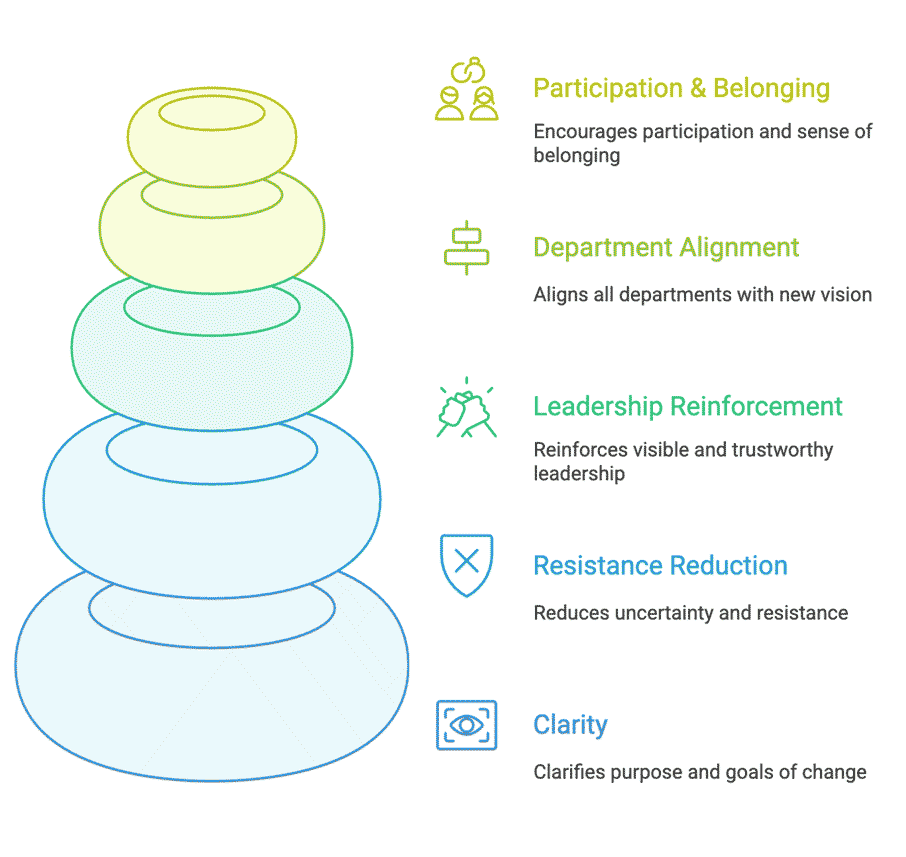
Benefits of integrating internal communication from day one
Clarifies the purpose and goals of the change
Reduces uncertainty and resistance
Reinforces visible and trustworthy leadership
Aligns all departments with the new vision
Encourages participation and a sense of belonging
Internal communication and organizational change
Consequences of poor communication during change
Weak communication doesn’t just cause confusion—it impacts the bottom line.
According to McKinsey The cost of unhappy workers, lmid-sized companies with poor change communication practices can lose between USD 228 and USD 355 million annually in productivity.
These figures only grow when organizational transformations fail to engage employees, a failure often caused by inadequate internal communication, one of the most common reasons change initiatives fall short.
The connection between leadership, internal communication, and business transformation
Visible leadership is one of the keys to success.
Experts agree that internal communication must be embedded into the change plan from day one.
At Oxean, as a global and regional internal communication agency, we recommend an integrated plan that anticipates all touchpoints, communication channels, formats, and spokespersons involved in the process.
Strategies to communicate change effectively in your organization
Designing an effective communication strategy in a corporate setting requires planning, empathy, and consistency.
Key steps for successful change communication
Diagnose the current state
Understand how communication flows and identify possible barriersDefine key messages
Decide what will be communicated, to whom, and in what toneSegment your audiences
Tailor messages according to departments, roles, and seniority levelsChoose the right channels
Mix digital platforms, in-person meetings, and audiovisual formatsEnsure leadership visibility
Involve executives as active spokespersons for the changeMeasure and adapt
Track how messages are received and adjust the strategy in real time
Continuous, transparent, and two-way communication is the best catalyst for successful organizational change.
Real-world cases of effective communication during change
Case 1 – Scotiabank: participation as the engine of change
According to a February 2024 Gartner study, Scotiabank designed a hybrid return-to-office (RTO) plan that was co-created with employees to ensure adoption.
This is a clear example of how two-way communication and involving people in the change design process can play a decisive role in the success of a transformation.
Case 2 – Grupo Mariposa: visible leadership in digital transformation
Grupo Mariposa in Guatemala developed a digital ecosystem based on AI. For two years, the president and CEO held weekly meetings with the transformation team.
The result: a more agile, connected, and results-driven internal culture.
In today’s business landscape, where transformation is constant, investing in solid internal communication strategies is not a luxury: it’s a necessity for long-term business sustainability.
We are a corporate communication agency focused on internal and external communication, with over 30 years of experience positively impacting global and LATAM companies.
FAQ - Internal Communication and Organizational Change
Why is internal communication essential during organizational change?
Because it connects strategy with people. At Oxean, we’ve seen that clear and consistent communication reduces resistance, builds trust, and helps teams understand the purpose behind each transformation.
What can happen when communication fails during a company transformation?
Poor communication can lead to confusion, lower productivity, and loss of confidence. According to Oxean, these issues directly affect workplace climate and can jeopardize the success of any change process.
How can internal communication support change management?
It acts as a bridge between leadership and employees. When included from the beginning, it aligns expectations, shares the purpose, and provides emotional support throughout the transition.
What role do leaders play in communicating organizational change?
Visible and empathetic leadership is crucial. Leaders should be active spokespeople, reinforce key messages, and create open dialogue spaces that strengthen internal trust and engagement.
What are the key steps to communicating transformation effectively?
At Oxean, we recommend diagnosing the situation, defining core messages, segmenting audiences, choosing the right channels, ensuring visible leadership, and measuring results to refine the strategy.
Why is it important to plan communication from the very start of a change process?
Anticipating team perceptions and emotions helps reduce uncertainty and prepare the ground for acceptance. Planned communication avoids improvisation and mixed messages.
How does effective internal communication enhance employee well-being and engagement?
Transparent communication and active listening make people feel valued and safe. This fosters well-being, motivation, and a stronger sense of belonging across the organization.