
Change management has become one of the most critical disciplines on the agenda of global organizations. Through this tool, people are prepared, supported, and empowered during the transition toward a future scenario.
In times of constant transformation, human adoption is the true turning point between success and failure. In this article, we share our proposal for carrying out the change management process.
What is change management?
Change management is defined as a structured approach that enables people to adopt new ways of working in a sustained manner.
It is a discipline that combines communication, training, visible leadership, and measurement to support the transition from the current state to the future state. Its main objective: to increase the speed, depth, and sustainability of adoption while minimizing friction and resistance.
Stages of the change management process (overview)
- Diagnosis and impact assessment.
- Experience and communication design.
- Support, metrics, and continuous improvement.
Why is it important to implement change management correctly?
According to a McKinsey study, fewer than one-third of respondents reported successful and sustainable transformations.
Therefore, implementing change management is key to preparing, supporting, and empowering employees during a transition from the present to the designed future scenario.

While project management falls under the responsibility of project managers, people adoption is the domain of change management.
Any change situation can be addressed through this discipline.
High-impact benefits
- Accelerates adoption and reduces resistance.
- Minimizes unintended impacts and value risks.
- Ensures sustainable return on investment.
- Empowers leaders and change agents as multipliers.
When is it appropriate to implement a change management process?
There are certain moments when change management becomes essential, for example:
- Company mergers
- Changes in leadership or business strategy
- Adoption of new IT or management systems
- Implementation of artificial intelligence
“Change management is a support tool focused on people. To ensure that people feel part of this process, an internal communication strategy that supports and communicates the real changes this transformation will bring is essential. And, above all, promoting dialogue without imposing, but rather supporting,”
says Laura Alonzo, change management lead at Oxean.
How to implement change management in your organization
Define objectives, impacts, and internal audiences.
Map leaders, ambassadors, and resistance points.
Design messages, training sessions, and experiences by microculture.
Measure adoption, sentiment, and engagement; adjust the plan accordingly.
Consolidate learnings and capitalize on capabilities.
Benefits of a structured transformation strategy
Undoubtedly, no transformation is possible without considering culture and internal microcultures.
This is highlighted in Deloitte’s 2024 Human capital trends report, which emphasizes that intervening at the team level — rather than only at the corporate level — increases agility and change capability.
Among the most notable benefits are:
- Accelerating the adoption of new tools, processes, or structures.
- Reducing resistance and unintended impacts.
- Ensuring that the investment delivers sustainable results.
- Empowering leaders and change agents as internal multipliers.
When change is not properly managed, the following may occur:
- Loss of value during the process.
- Projects that are implemented but not adopted.
- Misaligned employees.
- Poorly communicated workload overload.
- Leadership pulling in different directions.
Even transformations considered successful can leave value uncaptured if the human dimension is not integrated from the beginning.
What is Oxean’s change management service like?
As a corporate communications agency focused on internal and external communication, Oxean Cross provides change management services for organizations of all types.
“We meet with our clients to understand their needs and jointly build what the desired scenario would look like, where they want to go, and map out a roadmap that includes the pillars of change management based on what the organization requires,”
explains Laura Alonzo. She adds that,
“Change management is planned, measured, and analyzed. A path is outlined together with the client, and milestones are established within a defined timeline with deadlines and deliverables (maps, plans, surveys, questionnaires) that remain within the organization for future processes or as a record of what the organizational culture was.”
At Oxean, we propose a structured method that translates into tangible deliverables. As a result, each partner can see and measure the progress of change.
Oxean’s organizational transformation model
Oxean’s change management model is developed through the following stages:
1. Diagnosis and stakeholder mapping
Identification of needs, gaps, perceptions, and key leaders for each stage of the process.
2. Change experience design
Communication strategies, content, cultural activations, and training programs designed for each group and microculture.
3. Support and metrics
Ongoing measurement of adoption, sentiment, engagement, and business KPIs to adjust direction in real time.
The objective: to turn change efforts into sustainable transformations.
Recommended metrics for tracking
Some key metrics include:
- Adoption rate by milestone.
- Sentiment and climate (internal NPS).
- Training participation.
- Incidents and resolution time.
- Business KPIs associated with the change.
Recommended best practices
Experience shows that managing change is not just about communicating; rather, it is about creating shared meaning. Following best practices helps maintain process consistency and strengthen leadership.
- Integrate change management from the planning phase.
- Communicate clearly, simply, and consistently.
- Listen to teams and act on resistance.
- Measure and adjust continuously.
- Engage leaders as active spokespersons.

Change management is no longer a complement; today, it is a strategic capability. In a world where models, processes, and technologies are transforming, the differentiator lies in how people are supported toward the desired future.
Effective strategies for leading organizational transformation
Success depends on applying strategies tailored to people and context.
Some of the most effective include:
- A coherent and repeatable change narrative.
- Role-based and journey-based training.
- An ambassador network with visible leadership.
- Feedback loops and data-driven decisions.
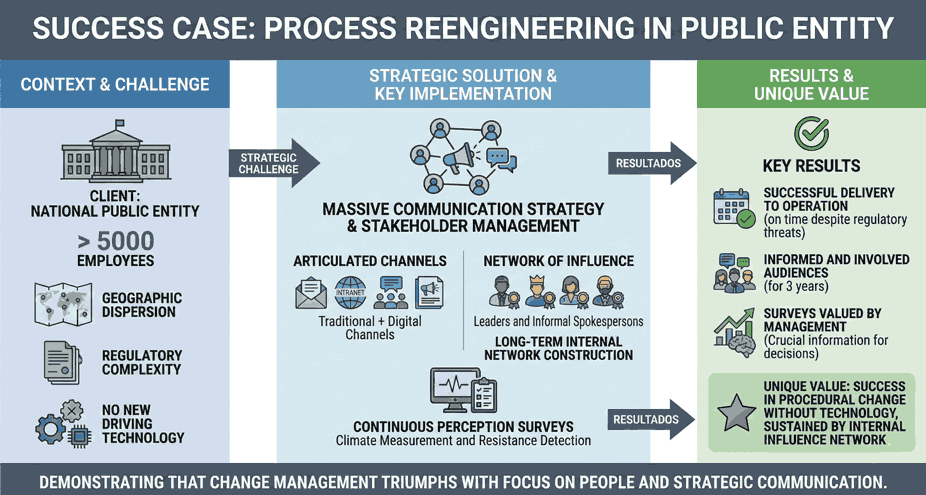
Oxean’s change management success stories
Click on each thumbnail to view the full infographic for each case.
Case 1
Case 2
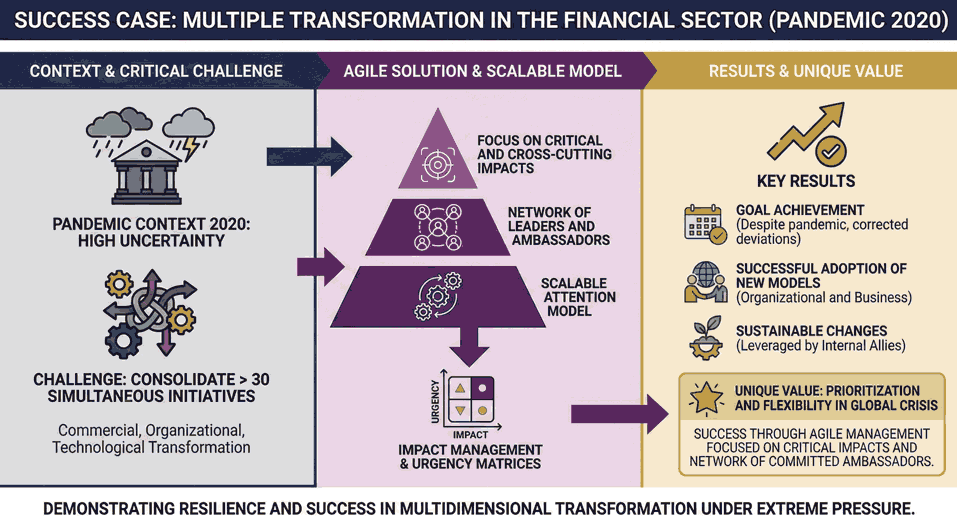
At Oxean, we manage the human side of change by combining methodology, specialized expertise, and strategies aimed at influencing how change and its associated effects are perceived, thereby ensuring that investment truly translates into results.
If your organization is undergoing a digital, cultural, or structural transformation, at Oxean we can design a change management plan that ensures adoption, engagement, and results.
FAQ – Frequently Asked Questions
What is change management?
Change management is a structured approach that helps people adopt new ways of working sustainably. It combines communication, training, visible leadership, and measurement to support the transition from the current state to a desired future state.
How is change management different from project management?
Project management focuses on delivering scope, timeline, and resources. Change management focuses on people adoption—reducing friction and resistance while increasing the speed, depth, and sustainability of behavioral and process change.
When should an organization activate a change management process?
It’s especially important during mergers, leadership or strategy changes, implementation of new systems (ERP/HR/IT), digital transformations, and AI adoption—any initiative that impacts roles, routines, or culture.
What are the key stages of an effective change management process?
A practical structure includes: (1) diagnosis and impact assessment/stakeholder mapping, (2) change experience design (communication, training, cultural activations), and (3) support with metrics and continuous improvement to keep adoption on track.
Which metrics help track adoption and adjust the plan?
Useful indicators include adoption rate by milestone, sentiment or climate measures (e.g., internal NPS), training participation, incidents and resolution time, and the business KPIs tied to the change (productivity, quality, time-to-value, etc.).
How can you reduce resistance and accelerate adoption in practice?
Build a clear change narrative, tailor communication and training by role and journey, create an ambassador network with visible leadership, and establish continuous feedback loops so you can address concerns early and make data-driven adjustments.