
In a corporate environment as dynamic as Latin America, companies are no longer looking only for diagnostics or reports: they are looking for practical solutions and measurable results. That is why regional internal communication consulting in Latin America has to be agile, adaptable by country, and, above all, actionable.
At Oxean, we understand that managing communication in a region with such diverse contexts requires speed, consistency, and a focus on execution. This is how we work across different markets in the region.
Consulting and strategy: from the “what” to the “how”
Today, Internal Communication (IC) is no longer a “support” area; instead, it has become a strategic driver: it boosts the business, protects people, and strengthens the brand.
In practice, that changes everything: consulting can no longer stay in theory. Organizations need support that translates business objectives into a concrete action plan, with owners, channels, a calendar, and measurement.
What regional internal communication consulting includes
- Message architecture (what is standardized and what is adapted by country)
- Governance (who defines, who approves, who publishes)
- Regional editorial calendar (cadence and priorities)
- Leader toolkits (so the message is sustained, not just “passed along”)
- Comparable KPIs by country (to demonstrate impact)
Thinking from a practical approach: less “publishing,” more “making it happen”
We have to keep in mind that it is no longer just about sending messages, but about providing strategic guidance. In this way, it becomes possible to align teams distributed across different time zones and local cultures under one shared purpose.
Therefore, a practical approach to IC makes it possible to optimize processes and reduce operational friction
According to Gallup’s latest report:companies with highly engaged teams—achieved through strategic and clear communication—reach profitability that is 23% higher than those with low engagement levels.
Consistency: where internal communication and employer branding meet
One of today’s greatest challenges is closing the gap between what a company says outwardly and what is actually experienced internally. Employer Branding is not a campaign; rather, it is the result of strong and consistent internal communication.
When IC is consistent:
- People understand the “why” and the “what for.”
- They become natural brand ambassadors.
- Talent loss decreases, especially among specialized profiles.
A simple example (and a very common one in regional organizations)
If the brand promises innovation externally, internal channels must reflect agility: timing, language, formats, feedback, and leadership all need to be aligned.Otherwise, the message breaks down… and it shows on the inside first.
For this reason, at Oxean we provide a practical approach that seeks to eliminate contradictions:
if the brand promises innovation externally, internal channels must breathe agility. This alignment is essential to retain talent in a market where competition for specialized profiles is fierce.

Safety, health, and environment: communication that saves lives
There are areas where strategic communication is not an option, but a critical necessity. In Safety, Health, and Environment departments, guidance must be specialized.
In Latin America, where extractive, manufacturing, and service industries carry significant weight, safety communication must be flawless, especially in organizations with multiple locations and shifts.
When employee safety is a priority
According to a report from the International Labour Organization (ILO),
workplace accidents and illnesses represent an annual economic loss equivalent to 4% of global GDP.
Therefore, at Oxean we work on SHE (Safety, Health, and Environment) as part of a comprehensive IC strategy that addresses employee safety. Making regulations known and ensuring compliance is important, but the key is to create a culture of prevention.
A solution-oriented approach to SHE seeks to:
- Simplify complex protocols (clear + visual + situational language).
- Create real environmental awareness (ESG).
- Ensure that every location has actionable information to work safely.
The technological leap: AI applied to internal communication
Artificial Intelligence is the tool that is allowing IC teams in Latin America to do more with less.
The Work Trend Index developed by Microsoft in partnership with LinkedIn indicates that
the adoption of these tools is massive: 75% of knowledge workers worldwide already use AI in their work to manage workloads and improve creativity.
The Global North vs. Global South gap: why training matters
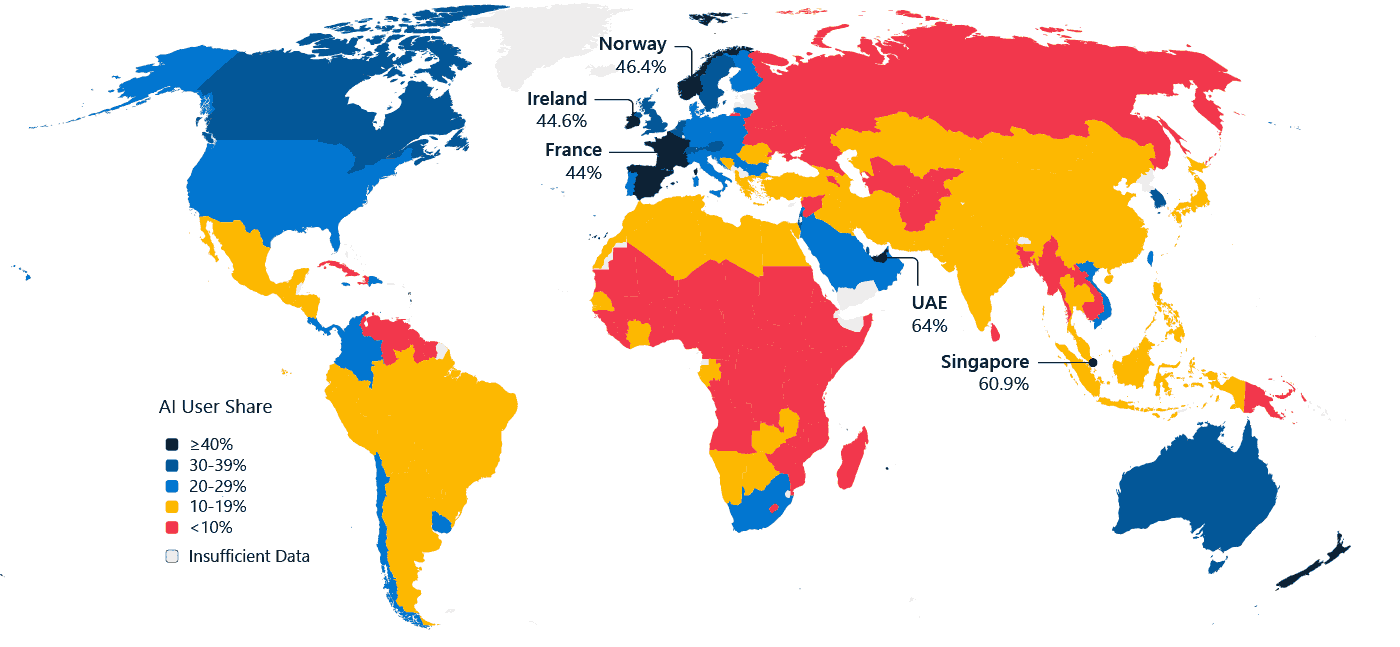
On the other hand, according to global AI adoption in 2025, Microsoft points out that:
24.7% of the working-age population in the Global North uses these tools, compared with 14.1% in the Global South.
In regional organizations, this translates into a specific challenge: if you do not train people and organize usage, “everyone with their own tool” appears, bringing risks of inconsistency, quality issues, and weak governance.
Spread of AI by economy in the second half of 2025
What we focus on at Oxean (applied AI, without empty promises)
We teach IC teams to use AI to optimize their processes, adapt content to different audiences, personalize messages, and analyze the organization’s sentiment.
Why choose a solution-oriented regional approach (when each site is different)
Being an agency focused on Latin America means understanding that a solution in Mexico may require different nuances than in Peru or Colombia, but that the final goal is the same: for the people who make up the organization to be aligned with the business.
We aim to be the partner that not only points out the problem, but also designs the architecture, chooses the channel, and trains the leader so the message reaches people, is understood, and drives action.
Is your company in Latin America and looking to transform your organization’s communication with tangible results? Would you like to schedule a brief consulting session so we can analyze the specific challenges of your operation?
FAQ – Frequently Asked Questions
What is regional internal communication consulting in Latin America?
It is a strategic and execution-focused service that helps companies align internal communication across multiple Latin American markets, combining regional consistency with local adaptation, governance, measurable KPIs, and practical action plans.
Why do companies need a practical internal communication consulting approach instead of only diagnostics?
Because organizations need more than reports: they need solutions they can implement. A practical consulting approach translates business goals into concrete actions, with clear owners, channels, timelines, and measurement frameworks that support execution.
What does a regional internal communication strategy usually include?
It typically includes message architecture, communication governance, a regional editorial calendar, leader toolkits, content adaptation by country, and comparable KPIs that make it possible to evaluate impact across markets.
How does internal communication connect with employer branding in regional organizations?
Employer branding becomes credible when the employee experience matches what the company communicates externally. Strong internal communication creates message consistency, reinforces culture, and helps employees become authentic brand ambassadors.
Why is specialized communication important in safety, health, and environment areas?
Because in SHE contexts, communication is operationally critical. It helps simplify complex protocols, improve compliance, create a prevention culture, and ensure that people in different sites and shifts receive clear, actionable information that supports safer behavior.
How can AI improve internal communication execution in Latin America?
AI can help teams optimize processes, adapt content for different audiences, personalize messages, and analyze sentiment more efficiently. When implemented with training and governance, it improves consistency, speed, and decision-making across regional communication operations.