
Gamification dynamics for companies can transform internal processes, training programs, and corporate campaigns into more participatory, measurable, and memorable experiences. When applied correctly, gamification to motivate teams is not about adding points, rankings, or symbolic rewards, but about designing experiences connected to real business goals.
In many organizations, the word “gamification” still creates some resistance. It is often associated with superficial dynamics, empty rankings, or symbolic prizes that have little to do with real business challenges.
But when it is well designed, gamification can be a very useful tool. It helps drive process adoption, improve indicators, and strengthen the employee experience.
Gamification: yes or no?
The answer lies in the approach.
It is not about “making people play.” It is about applying game mechanics —such as progress, challenges, feedback, recognition, and collaboration— to transform repetitive or complex tasks into clearer and more motivating experiences.
Today, companies across multiple industries use gamified dynamics to accelerate onboarding processes, reinforce organizational culture, improve internal training, and increase KPI compliance.
The goal is not to infantilize work. The goal is to generate greater participation, engagement, and clarity.
According to the book “The Gamification Revolution”, gamified experiences improve participation and knowledge retention when they are aligned with concrete business objectives.

Why gamification works in internal communication
Most internal initiatives fail for one simple reason: people do not always feel connected to the process.
A new procedure, an internal policy, mandatory training, or a monthly KPI is often communicated from the need to comply. But that is not always enough to generate attention, participation, or recall.
Gamification changes that logic. Employees do not only receive information. They also participate, move forward, and better understand the purpose of the action.
In internal communication, this can make an important difference. It does not make every process “fun.” It makes it clearer, more participatory, and easier to follow.
A well-designed dynamic combines three key elements:
- Visible progress: people can see how far they have advanced.
- Immediate feedback: they quickly understand whether they are doing things right.
- Shared purpose: the challenge stops being individual and becomes part of a collective goal.
This is where internal communication plays a key role. It explains the purpose, sustains the narrative, and shows why participation matters.
According to research by Gallup and Workhuman, employees who receive quality recognition are 45% less likely to leave the organization two years later. In addition, those who frequently receive valuable feedback are five times more likely to be engaged at work.
This reinforces a key idea: gamification does not work because of the reward itself. It works because of the experience of progress, recognition, and feedback built around an expected behavior.
3 gamification dynamics for companies that motivate teams
The best examples of gamification in companies are not always the most complex ones. They work when they connect an expected behavior with a simple and measurable experience.
In internal communication, these dynamics can be applied to different moments in the organizational journey:
- internal training;
- process adoption;
- safety and compliance;
- internal innovation;
- organizational culture;
- campaign participation;
- recognition;
- continuous improvement.
Below are three concrete dynamics that can be adapted to different industries, teams, and objectives..
1. The “Onboarding Rally”: turning induction into an experience
One of the most critical moments for any organization is the arrival of new talent.
Many companies still rely on long PDFs, lengthy meetings, or passive training sessions. The problem is not always the information itself. Many times, the problem is how it is presented.
The “Onboarding Rally” turns this stage into a participatory, progressive, and measurable experience. Instead of concentrating everything in one single instance, it proposes a journey with small missions. This way, new employees can get to know the culture, processes, people, and internal tools.
How it works
During the first few days, the person receives a “roadmap” with different missions linked to culture, processes, and internal networking.
Some examples:
- Mission 1: have coffee with someone from a different department and discover what their team does.
- Mission 2: find a key fact about the company’s history on the intranet.
- Mission 3: publish a first learning about the company’s vision on the internal social network.
- Mission 4: complete a short trivia quiz about benefits, values, or internal processes.
- Mission 5: identify who to contact for an operational, cultural, or administrative question.
Each completed mission can unlock new levels, digital badges, recognition messages, or access to new content.
The reward does not necessarily have to be material. Many times, the true value lies in feeling supported, recognized, and guided during the first few days.
Why it works
This dynamic reduces the anxiety that often comes with joining a new organization and accelerates informal learning. Instead of receiving information passively, the person begins to interact from day one with the culture, teams, and internal tools.
It also makes it possible to measure aspects that often remain invisible:
- Completed content: which materials were reviewed.
- Greater participation: which moments generated the most interaction.
- Frequent questions: which questions were repeated.
- Cross-area connection: which teams connected better.
- Improvement opportunities: which parts of onboarding need adjustment.
From an internal communication perspective, this also strengthens the sense of belonging. The welcome experience stops being a sequence of messages and becomes an actual experience.
A Gallup report indicates that only 12% of employees strongly agree that their organization does an excellent job onboarding new employees.
This data shows why onboarding should not depend only on documents, meetings, or passive training sessions. It needs clearer, more human, and more memorable experiences.
2. “Risk Hunters”: when process compliance stops being boring
In industries where safety, compliance, or operations are key issues, maintaining attention on protocols is often a challenge. Many times, these processes are perceived as repetitive.
Corporate gamification can transform passive compliance into active participation.
“Risk Hunters” is a dynamic designed for employees to detect errors, potential risks, or operational improvements that might otherwise go unnoticed.
The goal is not to turn compliance into a superficial competition. It is to help people participate more actively in continuous improvement.
How it works
Teams participate by identifying situations that may affect safety, quality, efficiency, or compliance with internal processes.
The proposal can be implemented through:
- a digital board;
- an internal app;
- a specific intranet channel;
- a campaign on the corporate social network;
- a shared physical space;
- short reports by team or area.
Each finding can add points, but the real value lies in rewarding resolution, not just detection.
For example:
- Detecting a minor risk: 5 points.
- Identifying an operational improvement: 10 points.
- Proposing a viable solution: 20 points.
- Implementing a validated improvement: extra score.
- Sharing the learning with another team: additional recognition.
The dynamic can be organized by teams or areas. This encourages collaboration, not individual rivalry.
What results does it generate?
This type of dynamic increases active participation in topics that usually generate little interaction. It also turns employees into protagonists of continuous improvement.
Instead of “following rules,” people feel they have a real voice. They see that their ideas can become concrete actions.
According to McKinsey,
organizational transformations reach a 79% success rate when employees actively participate in the change and feel they have a leading role in its implementation.

This explains why gamification dynamics based on collaboration, feedback, and participation tend to generate better results than purely informational approaches.
3. The “Ideas Market”: innovation with real participation
Many companies talk about internal innovation, but few create concrete spaces for people to propose solutions, validate ideas, and participate in decisions.
The “Ideas Market” makes it possible to gamify innovation without reducing it to a superficial competition.
This dynamic connects very well with organizational culture. It reinforces behaviors that many companies want to promote: collaboration, creativity, active listening, continuous improvement, and participation.
How it works
Each employee receives a certain number of “virtual coins” to invest in ideas proposed by other colleagues.
The challenges may be linked to:
- process improvement;
- customer experience;
- workplace climate;
- cost reduction;
- sustainability;
- productivity;
- internal communication;
- organizational culture;
- innovation in products or services.
The ideas with the most support move on to a validation, prototyping, or presentation stage with leaders.
The logic is simple: people do not only propose ideas; they also help prioritize which ones have the greatest value for the team or the organization.
What makes this dynamic interesting
It does not only encourage creativity. It also generates collective validation. People feel they have a real voice within the organization and that their proposals can become concrete actions.
In addition, the company obtains valuable information about the interests, priorities, and concerns of its teams.
The real differentiator: designing measurable experiences
Gamification only works when it is connected to clear objectives.
Before implementing any dynamic, the organization should ask itself:
- Behavior to promote: what action or habit do we want to encourage?
- KPI to improve: what indicator should change after the dynamic?
- Measurement: how will we evaluate participation, learning, and results?
- Employee experience: how do we want people to experience the process?
- Recognition: what type of incentive or appreciation makes sense for this culture?
- Organizational learning: what information do we need to gather to improve future actions?
The key is not in the prizes. It is in the experience of progress.
When people feel autonomy, challenge, and genuine recognition, participation stops feeling mandatory and begins to feel more voluntary.
Gamification and internal communication: a strategic combination
Internal communication can no longer be limited to informing. Today, it needs to generate experiences that mobilize behaviors, reinforce organizational culture, and facilitate change processes.
In this context, gamification appears as a particularly powerful tool for organizations that seek to:
- increase engagement;
- accelerate the adoption of new tools;
- improve onboarding experiences;
- strengthen culture;
- drive learning;
- promote collaboration;
- transform complex processes into more human experiences;
- make progress visible;
- generate genuine recognition.
But for this to happen, internal communication must participate from the design of the experience, not only from its promotion.
Its role is not only to communicate that a dynamic exists.
It must also:
- build the narrative;
- explain the purpose;
- facilitate participation;
- sustain interest;
- make progress visible;
- reinforce learnings;
- connect the dynamic with the organization’s objectives.
When internal communication participates from the beginning, gamification stops being an isolated action. It becomes a tool to support behaviors, processes, and culture.
Conclusion: gamifying is not entertaining, it is designing participation
Gamification dynamics for companies should not be understood as a layer of entertainment placed on top of boring processes.
Their true value appears when people understand better, participate more, and see how their progress contributes to a shared goal.
Gamification to motivate teams works when it combines autonomy, challenge, feedback, and genuine recognition. In other words, when it turns an internal action into a meaningful experience.
That is why the key is not in the prizes, but in the design of participation.
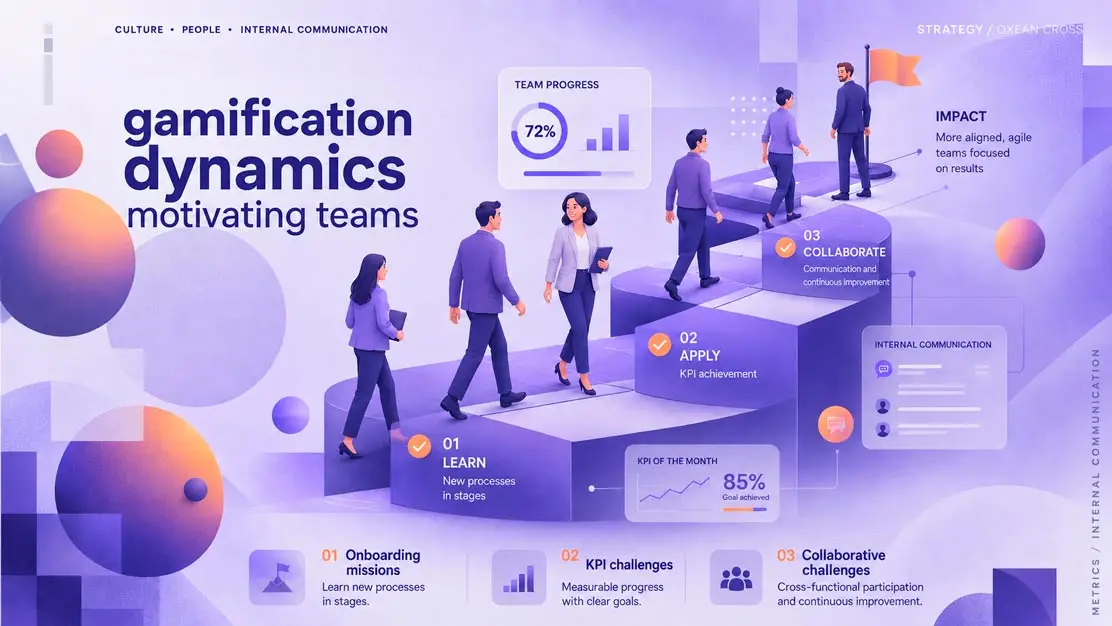
When an organization succeeds in making learning, collaboration, idea generation, or process adoption clearer and more relevant, participation stops feeling mandatory and begins to become part of the culture.
Does your organization need to turn learning and participation into more relevant, memorable, and effective experiences?
At Oxean, we can support you in designing a custom gamification strategy.FAQ – Frequently Asked Questions
What are gamification dynamics for companies?
Gamification dynamics for companies are structured experiences that apply game mechanics such as progress, challenges, feedback, recognition and collaboration to business processes, training programs, internal campaigns or cultural initiatives.
How can gamification motivate teams at work?
Gamification can motivate teams when it gives people a clear goal, visible progress, useful feedback and meaningful recognition. Its value is not in making work feel like a game, but in making participation clearer, more measurable and more engaging.
What are the best examples of gamification in internal communication?
Some effective examples include onboarding missions for new employees, compliance or safety challenges, innovation markets, learning journeys, recognition campaigns and team-based initiatives that encourage participation around a shared organizational goal.
Can gamification improve onboarding processes?
Yes. Gamification can improve onboarding by turning the first days of a new employee into a guided journey with small missions, cultural milestones, internal networking, learning checkpoints and feedback moments that make the experience more human and memorable.
How does gamification support compliance, safety or process adoption?
Gamification supports compliance, safety and process adoption by encouraging employees to participate actively, detect risks, complete tasks, share improvements and understand why each behavior matters for the organization, instead of simply receiving instructions.
What should a company measure in a gamification strategy?
A company should measure participation, completion rates, learning progress, behavior adoption, feedback quality, collaboration, engagement, improvement proposals and the impact of the dynamic on the business or communication objective it was designed to support.
What is the role of internal communication in corporate gamification?
Internal communication plays a strategic role in corporate gamification because it builds the narrative, explains the purpose, sustains participation, reinforces learning and connects the experience with culture, leadership and business priorities.
What mistakes should companies avoid when using gamification?
Companies should avoid using gamification as a superficial layer of points, rankings or prizes without a clear objective. A strong gamification strategy needs purpose, audience understanding, relevant incentives, measurable indicators and alignment with the company culture.