
Artificial intelligence skills for companies are becoming a strategic capability to compete, innovate, and improve the way organizations work and communicate.
AI is no longer a futuristic trend: today, it makes it possible to automate tasks, optimize decisions, accelerate content creation, and transform the relationship between leaders, teams, and organizational culture.
In the AI era, what is the real differentiator for companies?
Adopting artificial intelligence tools in isolation is not enough. The real competitive differentiator lies in developing skills that make it possible to use AI with strategic vision, critical thinking, and adaptability.
Today, many organizations are moving forward with the implementation of AI platforms, but few are seriously working on preparing their leaders and employees to coexist with this transformation.
And that is where one of the major challenges for internal communication appears.
Why AI also needs cultural support
A company can have AI tools and still not be prepared to use them correctly.
Before moving forward with AI adoption, organizations should keep in mind that:
- More tools do not guarantee greater organizational intelligence.
- Lack of training can turn AI into a source of resistance or misuse.
- Poorly communicated adoption usually moves forward in a fragmented way.
- The absence of clear ethical criteria weakens trust.
- When leadership does not provide support, AI is reduced to isolated experiments.
Forbes shares data from an Atlassian survey indicating the following:
- Executives were 84% more likely to focus on tools than on skills or training.
- Only 31% of workers said they had extensive opportunities to learn about AI.
The data exposes a clear gap: many companies are investing in technology, but they are still not developing the human and cultural capabilities needed to take advantage of it.
5 artificial intelligence skills for companies that want to adopt AI with good judgment
Artificial intelligence skills for companies are not limited to the technical mastery of a tool. They also include the ability to understand context, assess risks, communicate clearly, experiment in an organized way, and learn continuously.
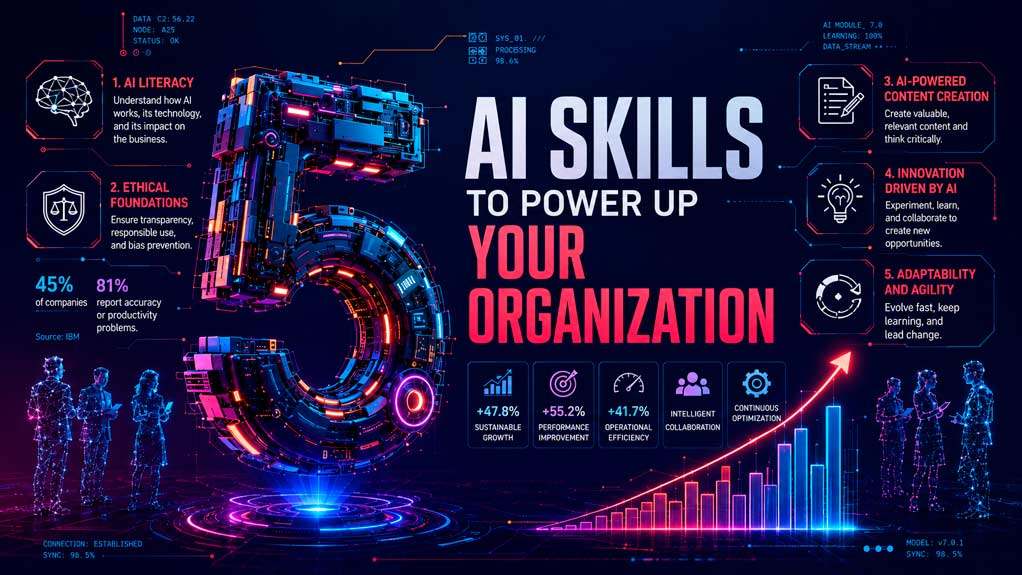
These are five key capabilities every organization should begin to develop.
1. AI literacy: understanding what technology can do and what its limits are
Talking about artificial intelligence can no longer be limited to IT, technology, or innovation areas. Companies need teams that are able to understand, at least at a basic level, how AI works and how it can impact their daily work.
AI literacy does not aim to turn every employee into a technical specialist. Its goal is for people to understand what artificial intelligence can do, what its limits are, and how to use it responsibly.
Basic AI concepts teams should know
Some concepts teams should begin to understand include:
- Machine learning.
- Deep learning.
- Natural language processing.
- Generative AI.
- Intelligent automation.
Of course, the goal is not for every employee to become a programmer. The goal is to build an organizational culture where people understand how AI can impact their tasks, their decisions, and the way they collaborate.
UNESCO emphasizes that AI literacy will be an essential skill for the future of work and education, especially when connected to ethics, practical applications, and critical thinking.
The role of internal communication in AI literacy
In this context, internal communication teams play a key role.
Internal communication can help to:
- Translate technical concepts into accessible messages.
- Reduce fears associated with automation.
- Promote spaces for continuous training.
- Generate conversations about the real impact of AI on the business.
- Align expectations between leaders, teams, and technical areas.
When people do not understand a technology, resistance often appears. When they understand it, they begin to explore opportunities.
2. AI ethics and governance: building trust before speed
One of the most frequent mistakes in adopting artificial intelligence is focusing only on efficiency and forgetting its ethical implications.
AI can amplify bias, reproduce misinformation, or generate results that lack transparency if there is no human oversight and no clear governance framework.
That is why developing ethical foundations in AI is no longer optional. It is a necessary condition for building trust.
According to the Open University of Catalonia, AI systems should be based on principles related to transparency, accountability, and privacy, among others.
Key questions for using AI responsibly
Within organizations, working on AI ethics means opening concrete conversations.
Some key questions include:
- What data does AI use?
- How are results validated?
- Who supervises automated decisions?
- Which tasks should remain human?
- How can bias be avoided in content, search, or automated processes?
- What reputational risks may appear?
Human verification: a necessary limit for generative AI
On the other hand, the growth of generative tools is creating new challenges related to the accuracy of information.
Even technology companies recognize that AI responses can contain errors and require human verification.
According to international research led by the European Broadcasting Union, generative AI systems still face significant challenges in accuracy, context, and attribution.
- 45% of responses may contain significant errors.
- 81% may have some type of issue related to accuracy, context, or attribution.
This does not mean companies should stop adopting AI. It means they need to move forward with clear criteria.
A company that adopts AI without governance may gain speed, but lose trust.
Organizations that succeed in creating mature conversations about digital ethics will achieve higher levels of internal trust and more sustainable adoption of artificial intelligence.

3. Content creation with AI: producing more without communicating worse
Generative AI has radically transformed the production of corporate content.
Today, it is possible to create drafts of articles, reports, presentations, summaries, internal campaigns, or messages for employees in a matter of minutes.
Tools such as Microsoft Copilot or Gemini are accelerating creative processes and improving productivity across multiple areas. Microsoft, for example, highlights that Copilot makes it possible to generate different types of content from simple natural language instructions.
But there is an important point: generating content does not necessarily mean communicating well.
The difference will continue to lie in the human ability to interpret contexts, detect nuances, and build messages that connect with people.
The human judgment behind AI-generated content
Content creation with AI needs human judgment to:
- Interpret contexts.
- Detect cultural sensitivity.
- Understand emotions.
- Build authentic narratives.
- Define tone and strategy.
- Review data, sources, and claims.
- Avoid generic or impersonal messages.
Why AI does not replace internal communication
In internal communication, this is especially relevant. Employees quickly detect when a message sounds cold, automatic, or disconnected from the organization’s reality.
AI can accelerate execution, but it still needs editorial supervision, critical thinking, and communication judgment.
The most advanced organizations are already working on hybrid models where AI automates repetitive tasks, while people focus on strategy, empathy, and culture building.
AI can accelerate content production, but communication still needs context, cultural sensitivity, editorial judgment, and a human tone.
4. Innovation with AI: experimenting without losing control
Many companies are still observing artificial intelligence from a theoretical standpoint. Others have already started experimenting.
In a context where technology changes constantly, the ability to test, learn, and adjust will be more valuable than waiting for absolute certainty.
AI-driven innovation means building an organizational culture where people can explore new uses of technology without losing sight of security, confidentiality, and business objectives.
How to drive more organized AI innovation
For AI innovation to be sustainable, companies need to:
- Encourage experimentation.
- Create quick pilots.
- Promote interdisciplinary collaboration.
- Accept error as part of learning.
- Define clear usage guidelines.
- Share learnings across areas.
- Avoid disorganized or informal use of AI tools.
Communication and leadership to reduce fear of change
This requires leadership, but also communication.
When companies communicate innovation only through fear —“we must adapt or be left behind”— they often create blockage.
Instead, when they present AI as a tool to enhance human capabilities, participation and engagement increase.
In addition, fostering a culture of innovation helps reduce one of today’s main risks: employees using AI tools without guidelines or corporate support.
That informal use can create security, reputational, and confidentiality issues. That is why organizations need to combine technological exploration with clear policies and continuous education.
Innovation with AI should not depend on isolated initiatives, but on a culture that allows people to experiment, learn, and organize knowledge.
5. Adaptability and continuous learning: the skill that runs through all the others
If there is one cross-functional competency in the AI era, it is the ability to adapt.
Tools change, models evolve, and processes are constantly redefined. What seems innovative today may become obsolete in just a few months.
That is why companies need to develop a continuous learning mindset.
Different studies on AI literacy agree that skills related to adaptation, critical thinking, and ongoing upskilling will be essential in the coming years.
In organizational terms, this means much more than offering a one-time training session.
What a company needs to adapt to AI
Adaptability requires:
- Constant training.
- Clear communication in the face of change.
- Flexible leadership.
- Interdisciplinary teams.
- A culture of continuous improvement.
- Openness to learning and unlearning.
- Spaces to share questions, learnings, and best practices.
Learning faster than technology
But it also means accepting something uncomfortable: no one has all the answers about AI yet.
The companies that adapt best will not necessarily be those with the most technology, but those that manage to build more curious, more agile organizations that are better prepared to learn.
In the AI era, the best-prepared companies will not necessarily be those with the most technology, but those that learn faster.
AI and internal communication: an increasingly strategic relationship
The transformation driven by artificial intelligence is not only technological. Above all, it is cultural.
Every AI implementation changes work dynamics, perceptions about the future, forms of collaboration, and relationships within organizations.
That is why internal communication will play an increasingly strategic role in:
- Supporting change processes.
- Reducing uncertainty.
- Building trust.
- Translating technological complexity.
- Driving new ways of learning.
AI is not here to replace the human dimension of work. But it does force companies to redefine which human capabilities will be most valuable.
And that conversation cannot remain only in the hands of technical areas. It also requires leadership, communication, culture, and participation.
AI adoption is not only a technological decision. It is a cultural transformation that needs communication, trust, and continuous learning.
Conclusion: AI needs technology, but also culture
Artificial intelligence skills for companies are not limited to the use of tools. They also involve judgment, ethics, creativity, innovation, and adaptability.
Technology can accelerate processes, improve productivity, and open new opportunities. But for that to happen sustainably, organizations need to prepare their people.
Because adopting AI is not just about learning how to use a platform. It is about learning to work in a different way.
Companies that develop these skills will be better prepared to innovate, communicate clearly, and build trust in a context of permanent change.
Preparing people to adopt AI with good judgment
If your organization is starting to work with AI, the challenge is not only choosing tools. It is also preparing people, organizing messages, and building a culture capable of learning.
At Oxean, we support organizations in internal communication, culture, and change processes so that technological adoption becomes clearer, more human, and more sustainable.
FAQ – Frequently Asked Questions
What artificial intelligence skills do companies need to develop?
Companies need to develop AI literacy, ethics and governance criteria, the ability to create content with human oversight, organized innovation, and continuous learning. These skills make it possible to adopt artificial intelligence with greater clarity, trust, and strategic sense.
Why is AI literacy important for teams?
Because it helps employees understand what artificial intelligence can do, what its limits are, and how it can impact their daily tasks. It is not about turning everyone into technical specialists, but about building an organizational culture prepared to use AI responsibly.
What role does ethics play in the adoption of artificial intelligence?
Ethics is key to avoiding bias, protecting data, validating results, and defining which decisions should continue to be supervised by people. A company that adopts AI without governance criteria may gain speed, but it can also lose internal and reputational trust.
Can artificial intelligence replace internal communication?
No. AI can accelerate content production, automate tasks, and help organize information, but internal communication still needs context, cultural sensitivity, editorial judgment, and a human understanding of the organization.
How can companies innovate with AI without losing control?
To innovate with AI without losing control, organizations should create pilots, define usage guidelines, protect confidentiality, share learnings across areas, and support experimentation with clear communication and active leadership.
Why is adaptability a central skill in the AI era?
Because tools, models, and ways of working are constantly changing. The best-prepared companies will not only be those with more technology, but those that can learn quickly, unlearn obsolete practices, and build more agile cultures.