In large organizations, artificial intelligence has moved beyond being a technological curiosity to become a professional challenge. The role of internal communicators in the age of AI can no longer be measured solely by how quickly they produce content.
While some Internal Communication teams use AI to write, summarize, or adapt messages, others are beginning to ask a deeper question: what value should communicators bring when much of the execution can be automated?
The answer is not simply about learning new tools. It requires rethinking how information flows, which decisions should remain in human hands, and what role Internal Communication plays in building culture, trust, and meaning.
The efficiency trap: moving beyond the content calendar
Today, Internal Communication teams seem to be divided between those using AI to do more of the same in less time and those who see it as an opportunity to redesign the relationship between organizations and their employees.
The ability to write, summarize, edit, or adapt messages with AI is becoming part of everyday work. However, automating content creation is only the surface.
The risk emerges when communication professionals remain trapped managing tasks that could increasingly be automated: filling content calendars, adapting formats, preparing drafts, or scheduling posts.
The real value lies in how time is used
According to Microsoft’s Work Trend Index 2026, 66% of surveyed AI users say these tools allow them to spend more time on high-value work. The report also highlights the growing importance of critical thinking and quality control as automation increases.
The real question, then, is not how much time a team can save, but how it chooses to reinvest that time.
Efficiency creates value only when it leads to better decisions, a deeper understanding of audiences, and the ability to solve more complex problems.
Otherwise, organizations risk falling into one of the most common mistakes in automating internal communication: producing more messages without necessarily improving communication.

How AI is changing the role of internal communicators
AI can already take on many visible communication tasks: drafting announcements, summarizing meetings, adapting content, preparing presentations, or scheduling communications.
This does not eliminate the communicator’s role.
On the contrary, it makes the value of professional judgment even more visible.
Internal communicators are moving beyond simply producing messages to becoming architects of the organization’s information and cultural environment.
Their responsibility increasingly involves deciding what information each audience needs, what can be automated, and when human intervention remains essential.
In this new environment, two capabilities become especially important:
- Judgment and contextual understanding: recognizing when communication can be handled through automation and when it requires visible leadership, active listening, and human sensitivity.
- Building trust: ensuring messages remain consistent with organizational culture and that technology does not weaken the authenticity of the organization’s voice.
New responsibilities for internal communicators: AI governance and ethics
For artificial intelligence to work effectively in a large organization, trust is essential.
That is why one of the emerging responsibilities of Internal Communication professionals is to help define clear rules for how AI should be used.
Internal Communication teams can contribute to decisions such as:
- What content can be generated with AI?
- Which messages require human review?
- Which communications should remain exclusively in human hands?
- How can organizations protect transparency, privacy, and information accuracy?
The UNESCO Recommendation on the Ethics of Artificial Intelligence highlights principles such as transparency, accountability, and human oversight. These principles are essential when establishing boundaries that protect leadership authenticity and employee trust.
Content creation will become increasingly simple and scalable. But the real value will lie in an organization’s ability to manage quality, ethics, and cultural consistency.
This also means developing new AI capabilities across the organization—not simply learning how to use tools, but understanding when, why, and under what conditions they should be used.
From operational executor to strategic partner: the evolution of internal communicators
The evolution of Internal Communication is creating an increasingly clear divide.
- On one side are strategic culture advisors who use data and insights to anticipate resistance to change and advise leadership.
- On the other are roles still focused almost exclusively on execution: producing communication pieces, managing channels, organizing calendars, and distributing messages.
Operational tasks will not disappear completely.
But they will carry less weight as a source of professional value. Many of them will be automated, integrated into platforms, or absorbed into broader workflows.
According to Deloitte’s 2026 Global Human Capital Trends, organizations that deliberately redesign roles and workflows to improve human-AI collaboration are twice as likely to exceed their expectations for return on investment.
The advantage does not come simply from adopting technology. It comes from redesigning work so technology amplifies human judgment.
Three ways internal communicators can lead the transition to AI
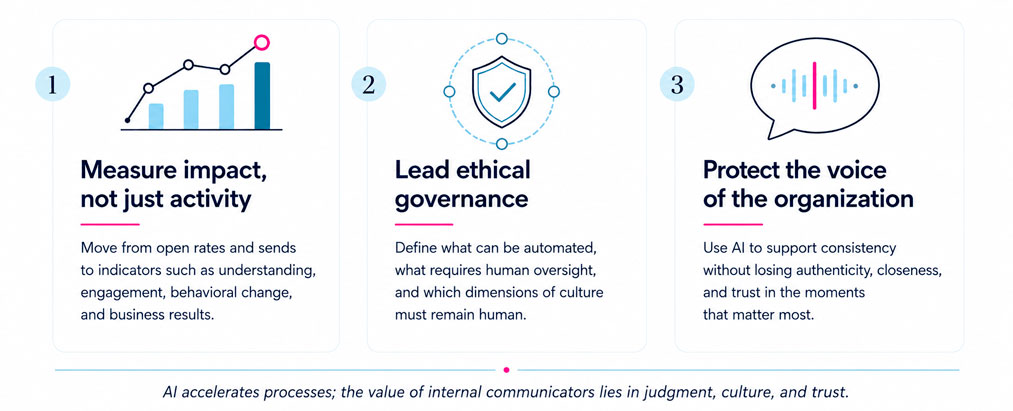
To evolve toward a more strategic role, Internal Communication teams need to reconsider what they measure, which decisions they own, and how they protect the organization’s voice.
- Move from measuring activity to measuring impact: go beyond isolated indicators such as the number of messages sent or open rates and focus instead on understanding, participation, behavioral change, and outcomes. Identifying the right internal communication metrics to measure real impact helps connect the function with business objectives.
- Lead ethical AI governance: participate in defining which tasks can be automated, which require human oversight, and which aspects of culture and leadership should remain exclusively human.
- Protect the organization’s voice: use AI to strengthen consistency in tone without replacing the spontaneous, human moments that create closeness, credibility, and trust.
Role of internal communicators in the age of AI
The role of Internal Communication in AI adoption
Beyond redefining their own professional role, internal communicators have another critical responsibility: supporting the adoption of artificial intelligence across the organization.
Many companies are implementing AI tools as part of broader technology strategies. Yet these initiatives often encounter operational and cultural barriers that cannot be solved through technical training alone.
Internal Communication can help by:
- maintaining continuous communication instead of relying only on isolated launch campaigns;
- systematically gathering insights about employees’ questions, needs, and difficulties;
- communicating how the organization is responding to employee questions, surveys, and experiences.
Collaboration between Internal Communication, Human Resources, and IT makes it possible to develop a stronger change management approach that supports adoption and connects AI implementation with organizational culture and business goals.
This is particularly important because adopting AI is not simply a technology implementation.
It is also a cultural transformation.
From message creator to culture architect
At Oxean, as a global agency specializing in internal communication, we believe technology is not here to replace communicators.
It is here to free them from mechanical tasks so they can focus on what matters most: strategy, judgment, and human connection.
Our team can support organizations with training to integrate AI into organizational culture and with the development of communication strategies tailored to their specific needs.
Let's talk about how to integrate artificial intelligence without losing culture, trust, or human judgment.
FAQ – Frequently Asked Questions
How is AI changing the role of internal communicators?
AI is automating many operational tasks such as drafting, summarizing, adapting content, preparing presentations, and scheduling communications. This shifts the value of internal communicators toward strategic judgment, audience understanding, cultural interpretation, trust building, and decisions about when human intervention is essential.
Will AI replace internal communication professionals?
AI can increasingly handle repetitive communication tasks, but it does not replace the need for professional judgment, contextual understanding, leadership sensitivity, active listening, and human connection. The communicator's role becomes more strategic as execution becomes easier to automate.
What new responsibilities do internal communicators have in the age of AI?
Internal communicators increasingly need to help define AI governance, determine which content can be automated, identify communications that require human review, protect transparency and privacy, maintain information accuracy, and preserve the organization's authentic voice and culture.
Why is AI governance important for Internal Communication?
AI governance helps organizations establish clear boundaries around automation, human oversight, transparency, privacy, accuracy, and accountability. These rules are essential for protecting employee trust, leadership authenticity, and cultural consistency as AI becomes more widely used.
How should internal communicators measure their impact in an AI-driven workplace?
They should move beyond activity metrics such as the number of messages sent or open rates and focus on indicators related to understanding, participation, behavioral change, employee response, and outcomes connected with organizational and business objectives.
What role does Internal Communication play in organizational AI adoption?
Internal Communication can support AI adoption by maintaining continuous communication, gathering employee questions and concerns, explaining how the organization responds to feedback, and collaborating with Human Resources and IT to connect technology implementation with change management, culture, and business goals.