
In some companies, HR and Internal Communication are part of the same structure; in others, they operate as independent functions. However, the real opportunity does not depend on the organizational chart, but on how both disciplines collaborate to improve people’s relationship with their work, their employer, and their future.
As a result, this collaboration helps align decisions, messages, and experiences. When both functions share objectives, they can build more consistent cultures, strengthen employee engagement, and better support the changes organizations go through.
Why Collaboration Between HR and Internal Communication Is Essential
Collaboration matters because Human Resources designs much of the employee experience, while Internal Communication helps ensure that experience is understood, consistent, and credible.
For years, Human Resources and Internal Communication operated with clearly differentiated responsibilities.
- Human Resources designed policies, managed talent-related processes, and supported professional development.
- Internal Communication, on the other hand, focused primarily on sharing information and making sure messages reached employees.
Today, that division is no longer enough.
The employee experience is not built by a single department. It is shaped through every interaction: from the job offer and onboarding to how change is communicated, relationships with leaders, recognition, and eventually an employee’s departure from the company.
That is why working in isolation is no longer a strategic option.
An integrated HR and Internal Communication strategy helps connect what the organization decides with the way employees understand and experience those decisions.
Employee Experience Requires an Integrated Approach
Employee experience depends both on what the organization does and on how people understand and experience each decision.
The concept of employee experience encompasses every stage a person goes through within an organization.
Gallup organizes the employee journey into stages including attraction, hiring, onboarding, engagement, performance, development, and departure.
Each stage combines two dimensions:
- What the organization does: policies, processes, benefits, opportunities, and decisions.
- How employees interpret it: messages, conversations, perceptions, and everyday experiences.
What Each Function Contributes to Employee Experience
- Human Resources designs people-related policies, processes, and experiences.
- Internal Communication translates those decisions into clear, relevant messages connected to organizational culture.
This is the real role of Internal Communication in employee experience: not simply communicating initiatives, but providing context, anticipating questions, and identifying potential resistance.
Early involvement allows Internal Communication to connect the talent strategy with organizational culture.
What Does an Organization Lose When HR and Internal Communication Work Separately?
When the two functions work separately, the organization loses consistency, listening capacity, and the ability to help employees understand and adopt change quickly.
Lack of Consistency Between Decisions and Messages
A policy, cultural transformation, or organizational restructuring may be well designed. But if employees do not understand its purpose or impact, meaningful adoption is unlikely to happen.
Working separately can also lead to disconnected messages, contradictions across channels, and employee experiences that do not reflect what the organization promises.
Late Communication and Lower Change Adoption
When Internal Communication is involved only at the end of a process, its role is reduced to “communicating” a decision that has already been made.
That means losing the opportunity to anticipate questions, identify resistance, and support employees throughout the process.
Coordination between HR and Internal Communication during organizational change allows both functions to contribute from the diagnosis stage—not only at launch.
Internal communication during organizational change requires information, listening, context, and trust. Oxean’s English article specifically frames internal communication as a strategic factor in helping organizations implement and sustain change.
Listening Without Follow-Through or Visible Action
Listening alone is not enough if data and feedback do not lead to decisions and visible responses.
According to Qualtrics, 87% of executives believe their organization effectively uses employee insights to improve employee experience. However, only 58% of employees believe their company is good at understanding and adapting to their needs.
This gap demonstrates the importance of interpreting information, responding to employees, and turning feedback into concrete action to rebuild employee trust
How to Integrate HR and Internal Communication
Integration does not require merging the two teams. It requires shared objectives, information, narratives, and metrics.
There are four pillars that can help build a systematic working relationship between both functions.
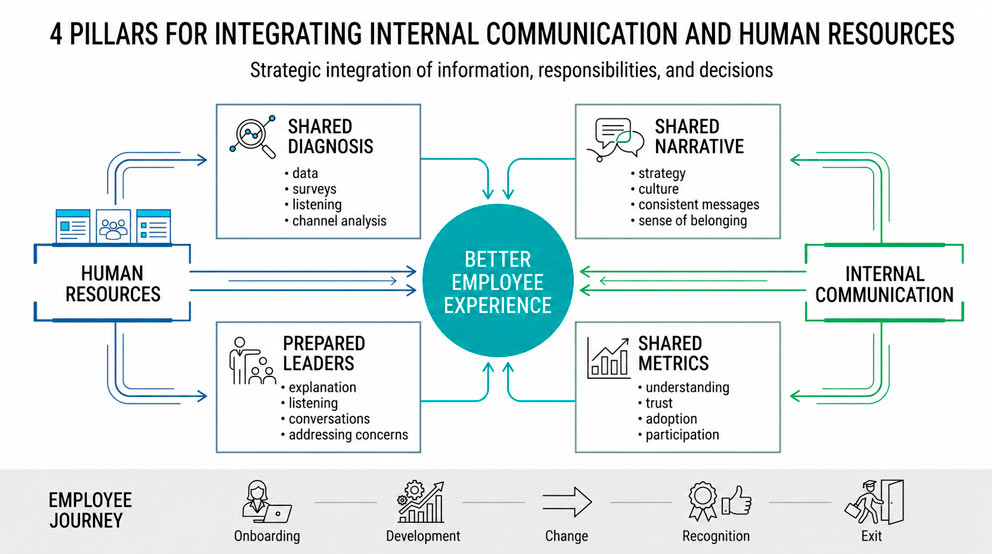
Integration begins with a shared diagnosis, a consistent narrative, well-prepared leaders, and common indicators.
1. Build a Shared HR and Internal Communication Diagnosis
Employee surveys, organizational culture studies, conversations with leaders, channel analysis, and engagement metrics can help both functions build a shared view of employee needs and communication barriers.
This diagnosis can identify opportunities such as improving onboarding, strengthening leadership, or supporting organizational transformation.
It also prevents each function from designing solutions for completely different problems.
To explore this approach further, you can read Oxean’s guide on global Internal Communication diagnosis, which covers objectives, data collection, analysis, channels, stakeholders, and improvement plans.
2. Create a Shared Narrative Between Strategy and Culture
Organizations communicate structural changes, well-being programs, benefits, and business decisions.
The challenge is preventing employees from experiencing them as disconnected initiatives.
Human Resources contributes its knowledge of people and talent strategy.
Internal Communication turns that information into a narrative that helps employees understand the bigger picture and develop a stronger sense of belonging.
The goal is not simply to announce each HR initiative separately, but to connect decisions so employees can understand how they relate to the organization’s culture, priorities, and direction.
3. Prepare Leaders to Communicate
Employees often look to their direct leaders for answers before turning to corporate channels.
That is why leaders need the tools to explain decisions, listen to concerns, and connect organizational strategy with everyday work.
The Institute of Internal Communication’s IC Index 2025 found that only 13% of employees give their organization top marks for internal communication, while 82% say they are clearer on strategy when they hear directly from the CEO or most senior leader.
Preparing spokespeople, key messages, and responses therefore helps strengthen leadership through effective internal communication.
4. Define Shared Metrics Between HR and Internal Communication
Open rates and clicks are useful data points, but they are not enough to evaluate impact.
Both functions should measure:
- understanding of messages and organizational priorities;
- perceptions of culture and leadership;
- adoption of new behaviors;
- participation and quality of feedback;
- changes across key moments in the employee journey.
Integrated measurement makes it easier to demonstrate how communication and people initiatives contribute to trust, engagement, retention, and change management.
It also moves reporting away from isolated communication outputs and HR indicators toward a shared understanding of the employee experience.
From Separate Functions to a Shared Operating Model
The boundary between Human Resources and Internal Communication is becoming increasingly fluid because both disciplines address the same underlying challenge: building a better relationship between people and the organization.
In an environment where organizations compete for both customers and talent, communicating who they are, what they stand for, and how they support their people becomes a strategic differentiator.
Organizations that build a strong partnership between HR and Internal Communication will be better equipped to create consistent cultures and support transformation.

Oxean, as an Internal Communication agency and consulting firm, we work with Human Resources, People & Culture, and Communication teams to design assessments, strategies, narratives, and initiatives that connect culture, reputation, and business.
The future of Internal Communication will not simply be about telling employees what is happening inside an organization. It will play a strategic role in helping shape what happens next.
FAQ – Frequently Asked Questions
Why should HR and Internal Communication work together?
Both functions influence the relationship between people and the organization. HR designs policies, processes, and employee experiences, while Internal Communication helps employees understand those decisions, connect them with organizational culture, and know how they affect their everyday work.
How do HR and Internal Communication improve employee experience?
HR shapes many of the policies, processes, benefits, and development opportunities employees experience, while Internal Communication provides clarity, context, and consistency. Working together helps ensure that what the organization does and what employees understand and experience are aligned throughout the employee journey.
What happens when HR and Internal Communication work separately?
Working in isolation can create inconsistencies between decisions and messages, reduce employees’ understanding of organizational changes, and make communication reactive rather than strategic. It can also weaken listening processes when employee feedback is collected but does not lead to visible action.
How can organizations integrate HR and Internal Communication?
Integration can begin with a shared diagnosis of employee needs, communication barriers, culture, and organizational priorities. From there, both functions can develop a consistent narrative, prepare leaders to communicate effectively, and establish common objectives and metrics. Integration does not necessarily require merging the two teams.
What role do leaders play in HR and Internal Communication strategies?
Leaders help translate organizational decisions into the everyday reality of their teams. Preparing them with clear messages, context, listening tools, and answers to expected questions enables them to explain decisions, address concerns, and connect business strategy with employees’ daily work.
What metrics should HR and Internal Communication share?
Beyond open rates and clicks, both functions should measure employee understanding, perceptions of culture and leadership, adoption of new behaviors, participation, quality of feedback, and changes across key moments in the employee journey. Shared metrics help connect communication and people initiatives with trust, engagement, retention, and change management.