
Understanding noise vs. impact in internal communication means distinguishing between an organization that communicates constantly and one whose messages actually help people understand, decide, or act. An effective strategy therefore needs purpose, coordinated channels, and clear criteria for measuring results.
Many organizations send more content than ever, yet engagement does not improve and employee survey results show little progress. The real question, then, is not how much an organization communicates, but what effect each message has on the person receiving it.
In this article, we explore four signs that can reveal whether an internal communication strategy is generating noise instead of impact.
Noise vs. impact in internal communication: why it can be hard to tell the difference
Volume shows how much an organization communicates. Impact reveals what changes because of that communication.
When an organization communicates frequently, it can easily confuse volume with results. An Internal Communication team may constantly produce content and still fail to ensure that employees understand and remember what matters.
The data shows how common this problem is:
- According to Gartner, as cited by Harvard Business Review, 38% of employees say they receive an “excessive” volume of communication. At the same time, only 13% reported receiving less information in 2022 than in the previous year.
- Research from Korbyt and Reworked, shared by ICology, found that 44% of employees tune out workplace communication even when they consider the volume of messages to be about right.
In other words, communicating more does not guarantee greater impact.
Repetitive, generic, or non-actionable content gradually loses relevance and purpose.
To explore information saturation in more depth, you can also read our article on workplace information overload.
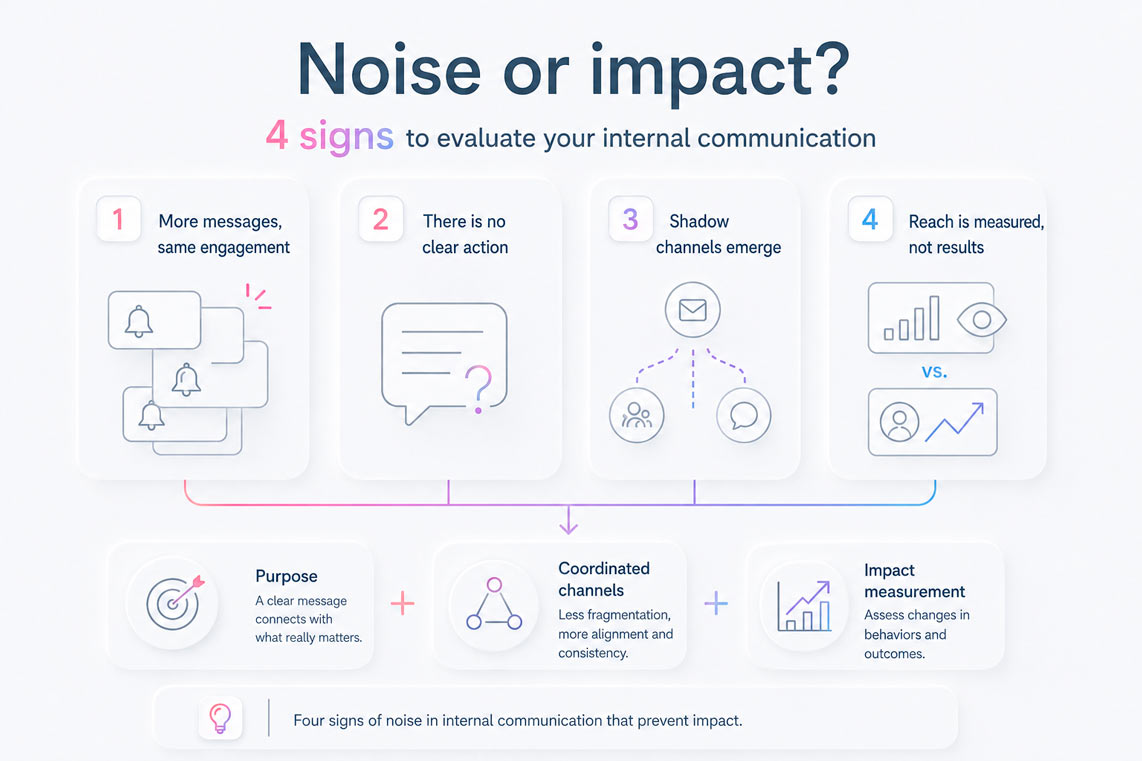
Sign 1: message volume increases and the same content is repeated across every channel
The first warning sign appears when the number of internal messages increases, but participation, understanding, or employee engagement does not improve.
According to a SWOOP Analytics survey of 286 professionals across the Americas, APAC, and EMEA, 74% said employees in their organizations were constantly or frequently dealing with information overload.
Meanwhile, Brosix reports that 73% of professionals have seen an increase in the variety of communication channels used over the previous 12 months. It also reports that 60% experience high stress and burnout linked to online communication fatigue.

Multichannel communication does not mean duplicating the same message
Using multiple channels may be necessary.
However, a multichannel strategy is not about copying the same content into email, the intranet, and corporate chat.
An email might introduce the information; the intranet can centralize documentation; and a team conversation can provide context.
By contrast, when every channel repeats exactly the same thing, they compete for attention and make it harder for employees to identify the authoritative source.
The problem, therefore, is not using different channels.
It is using them without defining the role each one should play.
When everything is published everywhere, employees stop knowing where to look for reliable information and which messages require immediate action.
What to review before sending another internal message
Before adding another communication, ask:
- Did the previous message generate a reaction, understanding, or change?
- Could this information be incorporated into content that is already planned?
- Does each channel serve a different purpose?
- Does the message really need to reach the entire organization?
- Is the communication responding to a genuine need—or simply to the habit of sending something “just in case”?
Sign 2: internal messages do not make it clear what employees should do
An internal message can be well written and still fail to generate results if people finish reading without understanding what they need to know, remember, or do.
A simple test is to complete this sentence:
“After reading this message, employees will…”
If finishing that sentence is difficult, the communication is probably not ready yet.
As we explain in our guide to effective internal messages, internal communication competes with multiple channels, interruptions, and limited attention. A message without a clear purpose or expected action can disappear before creating any meaningful effect.
What to review before sending an internal communication
- What does the person need to know, think, or do?
- Does the primary action appear within the first few lines?
- Does the message explain why the topic matters?
- Is it relevant to every audience, or should it be segmented?
- Does the selected channel make the expected action easier?
It is also important to distinguish between informing and prompting action.
Not every message needs to request an immediate task, but every message should make the organization’s expectation clear: understand a decision, remember a date, adopt a behavior, or participate in an initiative.
In short, a message that does not guide the audience toward a clear response can consume attention without creating value.
Sign 3: shadow communication channels begin competing with official channels
When official channels do not meet employees’ information needs, people look elsewhere for answers: WhatsApp groups, direct messages, informal chats, or hallway conversations.
This phenomenon is often referred to as shadow comms or unofficial communication.
Rather than being simply a discipline problem, it can indicate that formal channels have lost speed, clarity, proximity, or credibility.
Research shared by ICology makes the same point: when official channels fail, employees do not stop looking for information—they move to direct messages, WhatsApp groups, texts, and informal conversations instead.
What needs do shadow communication channels meet?
Informal spaces usually provide something the official communication system is not delivering:
- faster, more specific answers;
- the opportunity to ask questions and follow up;
- information adapted to everyday work;
- proximity to a familiar and trusted source;
- confirmation that an official message is still accurate or current.
These channels can also reveal that managers have become the de facto source of information without shared communication guidelines.
For that reason, shadow communication channels can provide honest feedback about the official system and help identify information needs that remain unresolved.
Sign 4: you measure internal communication reach, but not its real impact
The fourth warning sign appears when reporting focuses primarily on open rates, views, reach, or the number of communication pieces produced.
These metrics are useful.
But they do not demonstrate changes in understanding or behavior.
As we explain in our article on internal communication metrics, measuring volume is much easier than measuring outcomes. A strategy can display impressive numbers and still fail to achieve its actual objectives.
Activity, reach, and impact are not the same
To evaluate an internal communication strategy more effectively, it helps to distinguish between three levels:
- Activity: how many messages, campaigns, or communication pieces the team produced.
- Reach: how many people received, opened, or viewed them.
- Impact: what employees understood, decided, or did afterward.
For example, a high open rate may show that an email subject line worked.
But only a reduction in repeated questions, adoption of a new process, or improved understanding can tell you whether the communication actually achieved its purpose.
This distinction also improves reporting.
Activity metrics explain what the team did. Reach metrics show how far the communication traveled. Impact metrics reveal whether communication contributed to the intended outcome.
How to measure the real impact of internal communication
In addition to reach, organizations should look at:
- changes in behavior or understanding after a campaign;
- a reduction in repeated questions about information already communicated;
- participation in two-way communication spaces and the quality of feedback;
- adoption of tools, processes, or initiatives;
- changes in indicators connected to the relevant business objective.
Counting messages tells you how much the Internal Communication team produced.
It does not tell you whether that effort created meaningful change.
How to move from internal communication noise to impact
Reducing internal communication noise does not automatically mean communicating less. It means making better decisions about what to communicate, to whom, through which channel, and for what purpose.
Before adding another piece of content, the Internal Communication team should be able to explain why it is necessary, which audience needs it, where it should appear, and how its effectiveness will be evaluated.
Four elements are especially important:
- Purpose: what result should the message generate?
- Priority: which information deserves immediate attention and which can wait?
- Channel: where should it be published to avoid unnecessary duplication?
- Measurement: which indicator will show whether the communication had the intended effect?
This shifts the strategy away from evaluating performance based on the number of messages produced and toward its ability to generate understanding, trust, and action.
At Oxean, as a corporate communication agency specializing in Internal Communication, we help organizations identify when communication volume stops translating into results and redesign their strategies across messages, channels, and measurement.
FAQ – Frequently Asked Questions
What is the difference between noise vs. impact in internal communication?
Noise refers to the volume of messages an organization produces, while impact refers to what changes because of those messages. Internal communication creates impact when employees understand what matters, know what is expected, and are able to make decisions or take action as a result.
How can too much internal communication reduce employee engagement?
When employees receive repetitive, generic, or non-actionable messages across multiple channels, important information becomes harder to identify. Increasing communication volume without a clear purpose can create information overload and make employees more likely to ignore future messages.
Why should the same internal message not be repeated across every channel?
Each channel should have a specific role. Email can introduce information, the intranet can centralize documentation, and managers or team conversations can provide context. Repeating exactly the same message everywhere creates unnecessary competition for attention and can make it unclear where employees should look for authoritative information.
What are shadow communication channels in the workplace?
Shadow communication channels are unofficial spaces such as WhatsApp groups, direct messages, informal chats, or hallway conversations where employees look for information when official channels do not meet their needs. Their growth can signal problems with the speed, clarity, relevance, or credibility of formal internal communication.
How can companies measure noise vs. impact in internal communication?
Companies should look beyond open rates, views, and reach. Useful impact indicators include changes in employee understanding or behavior, reductions in repeated questions, participation in two-way communication, adoption of tools or processes, and progress in indicators connected to the relevant business objective.
How can an organization reduce internal communication noise?
Reducing noise does not necessarily mean communicating less. It means making better decisions about purpose, audience, priority, channel, and measurement. Before sending a message, teams should be able to explain why it is necessary, who needs it, where it should appear, and how they will know whether it worked.