
Today more than ever, a 360 communication agency is essential for integrating messages, unifying strategies, and building a solid narrative in a business environment shaped by digital transformation and the speed of information.
In this article, we’ll explain what 360 communication is, how it differs from traditional communication, why hiring a specialized agency makes sense, and which types of organizations can benefit the most.
What is 360 communication and how does a full-service communication agency work?
360 communication—also known as integrated communication—is a strategic approach that coordinates all of a company’s messaging, channels, and audiences. This includes:
Internal initiatives like the intranet, internal campaigns, and team communication
External actions such as social media, press, digital content, and corporate spokespersons
Unlike traditional communication, where each area works in silos, 360 communication:
Aligns the corporate purpose with daily actions
Connects internal and external audiences under a unified narrative
Turns communication into a strategic business driver
This integrated vision addresses a key challenge today: brands are no longer just competing for attention—they’re competing to build trust and lasting relationships.
Traditional communication vs. a 360 communication agency: main differences
Traditional communication
- Isolated, task-oriented actions
- Inconsistent messages across channels
- Limited impact measurement
- Operative role
360 communication
- Strategy embedded throughout the organization
- Unified narrative across all touchpoints
- Integrated metrics and dashboards
- Strategic role
This integration is no longer optional; managing communication and the human experience as an ecosystem is a global priority trend for modern companies.
Why should your company hire a 360 communication agency?
Working with a specialized 360 communication agency offers several key advantages:
1. Align reputation, culture, and business
Consistent communication strengthens identity, purpose, and trust.
An Ipsos report treveals that, on average, 70% of consumers across 25 countries say they buy from brands whose values align with their own.
2.Turn communication into real engagement
According to Gallup, only 21% of global employees feel genuinely engaged at work—the lowest figure in nearly a decade.
And this isn’t just a People issue—it directly impacts business results.
A 360 agency addresses engagement from the core of the organization: its people. The result is higher productivity, better retention, and a healthier work culture.
3. Optimize resources with a specialized partner
Centralizing strategy, content, metrics, and corporate messaging reduces duplication, speeds up execution, and improves communication quality.
Implement actionable metrics
Leading companies track KPIs like Engagement Score, Brand Lift, and cultural adoption to make real-time decisions.
This is only possible through a 360 approach.
Benefits of working with a strategic 360 communication agency
- Message governance and strategic vision: clarity on what to communicate, who should say it, when, and how
- Business-communication alignment: the agency translates business goals into cohesive internal and external communication plans
- Operational efficiency and economies of scale: centralization of creativity, media, content, and measurement
- Shared KPIs and dashboards: allow for real impact tracking and campaign optimization
- Change management and reputation risk mitigation: especially during transformations (integrations, restructurings, AI adoption), 360 communication helps reduce uncertainty and speed up adoption
McKinsey notes that communication during mergers and acquisitions is a critical factor in successful integration.
What types of companies benefit most from a corporate 360 communication agency?
This model is especially relevant for:
Companies undergoing digital transformation or restructuring:
Where cultural and behavioral shifts are essentialMulti-country or omnichannel companies:
Where message consistency across markets and channels is critical for brand reputation and customer experienceOrganizations focused on talent retention:
In industries facing talent shortages, clear internal programs boost engagement
(Recent engagement data shows employee experience is now a structural priority)Highly regulated or reputation-sensitive sectors:
Such as fintech, healthcare, and energy, where coordination between internal and external communication is vitalCompanies needing to link communication to business outcomes
When “making noise” isn’t enough, and real ROI must be shown
In these contexts, communication stops being a cost and becomes a strategic lever.
What is purpose-driven communication and how does it connect to 360 communication?
The era of isolated messages is over. Today’s leading brands:
Connect their corporate purpose to tangible actions
Maintain a consistent story across all channels
Measure their impact on culture, business, and people
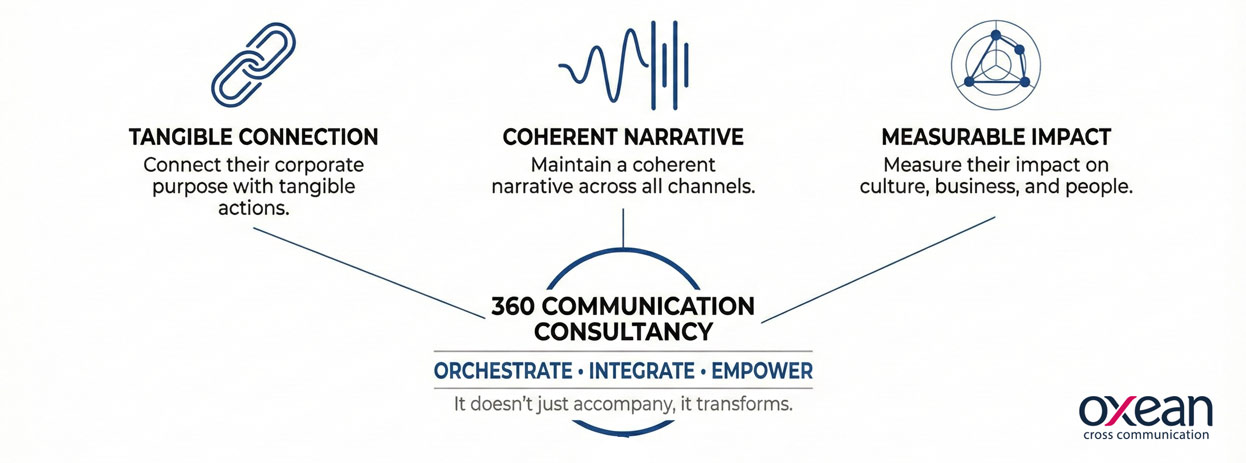
A 360 communication consultancy doesn’t just support—it orchestrates, integrates, and empowers.
This approach translates into sustainable competitiveness and a consistent experience at every level of the organization.
If your company is looking for clearer, more consistent, and more strategic communication—now is the time to take the leap. A 360 communication agency can help transform your culture, enhance internal and external experiences, and align your reputation, narrative, and business.
Contact us today and let’s design the 360 communication strategy your company needs to grow with confidence.
FAQ – Frequently Asked Questions
What can a 360 communication agency contribute to my company?
It can align all corporate messages, build a consistent internal and external narrative, and connect communication actions with strategic business goals.
In what situations is a 360 approach especially important?
A 360 strategy is essential during digital transformation, culture change, international expansion, or when a company needs to strengthen its reputation with diverse audiences.
Why choose a communication agency instead of managing everything in-house?
An agency brings external perspective, cross-industry experience, proven methodologies, and specialized teams—resources that are often difficult to build and sustain internally.
How does internal communication fit into a 360 strategy?
It becomes a central pillar: employees move from being passive recipients of information to active ambassadors, with content aligned to purpose, culture, and the talent value proposition.
What sets a 360 communication agency apart from a tactical provider?
A 360 agency provides diagnostics, message governance, KPIs, integrated planning, and channel coordination—far beyond producing isolated pieces or campaigns.
Which indicators help measure the impact of a 360 communication strategy?
Key metrics include employee engagement, brand perception, media tone and coverage, digital performance, participation in corporate initiatives, and correlation with business outcomes.