
The consistency between employer brand and employee experience determines how credible an organization is as a place to work. When what a company communicates does not match what people actually experience, its employer brand loses credibility—even when the campaign, values, or employee value proposition are well defined.
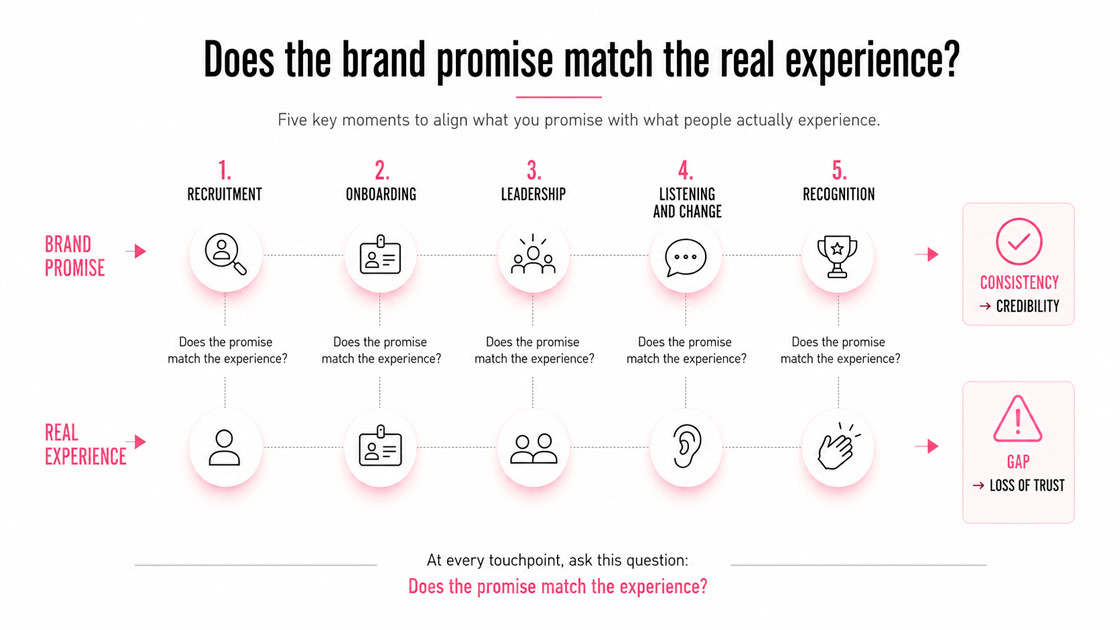
That gap often becomes visible at specific moments: onboarding, leadership, organizational change, employee listening, and recognition. Closing it requires aligning messages, practices, and decisions, not simply creating more attractive communication.
The challenge, then, is not to build an idealized version of the organization, but to align employer brand with employee experience so that the external promise can be recognized in employees’ everyday reality.
Employer brand is the promise an organization makes about what it is like to work there. Employee experience is how that promise is actually lived across recruitment, onboarding, leadership, development, recognition, and organizational change.
What Happens When Employer Brand and Employee Experience Don't Align?
When employer brand and employee experience do not align, the employer brand promise loses credibility and employees and candidates become more likely to trust experiences shared by others than the organization’s official messaging.
In 2017, Weber Shandwick and KRC Research surveyed approximately 1,900 employees across 19 markets and found that only 19% perceived a strong match between how their employer represented itself and their actual experience at work.
The issue remains relevant today.
The 2026 State of Employer Reputation and Visibility Report from Built In found that only 24% of surveyed Talent Acquisition and HR leaders believed their organization’s internal and external perceptions were aligned.
The studies look at the issue from different perspectives, but they point to the same risk: when the employee experience does not support the promise, the employer brand begins to be shaped by what people can verify—not only by what the organization communicates.
Why Does a Gap Emerge Between Employer Brand and Employee Experience?
The gap between employer brand and employee experience emerges when the employee value proposition, messaging, and campaigns evolve separately from actual practices, leadership behaviors, or working conditions.
Organizations change.
Sometimes their narrative does not change with them.
Common causes include:
- an employee value proposition defined without validating the actual employee experience;
- organizational changes that shift priorities without updating the narrative;
- leaders who communicate openness but behave with little transparency;
- well-being messages that coexist with workplace dynamics that contradict them;
- employee listening channels that collect feedback without showing what happened afterward.
Internal Communication cannot resolve all of these inconsistencies on its own.
But it can detect them, make them visible, and prevent an organizational promise from being amplified before the company is actually able to deliver on it.
Where Does Employer Brand Inconsistency Show Up First?
Employer brand inconsistency becomes visible when an institutional promise comes into contact with a real employee experience. That is where employees compare what the organization says with what actually happens.
Employer Brand and Onboarding: The First Test of Credibility
Onboarding is one of the first moments when the employer promise is put to the test.
If recruitment conversations emphasized autonomy, career development, or flexibility, the first few weeks should provide experiences that support those expectations.
A significant gap between promise and reality can create doubt before the employment relationship has even had time to fully develop.
Organizational Change, Employee Listening, and Recognition
The same tension appears when:
- an organization announces a cultural transformation without changing leadership behaviors;
- employees are asked for feedback, but nothing is communicated about what happened as a result;
- recognition programs are promoted but teams perceive them as difficult to access;
- well-being is emphasized while workplace issues persist that contradict the message.
Inconsistency does not always begin with a major crisis.
It can accumulate through small signals until it becomes a lasting perception.
What Are the Costs of an Employer Brand That Lacks Credibility?
An employer brand that lacks credibility affects internal trust, talent attraction, and the organization’s ability to sustain the credibility of future messages.
The gap between what an organization says and what employees experience can lead to:
- lower credibility for institutional communications;
- middle managers having to explain promises they do not control;
- informal channels gaining authority over official ones;
- a growing gap between internal reputation and external positioning;
- employees questioning future messages based on previous experiences.
That is why inconsistency is not simply a communication problem.
It can be a sign that employee experience, organizational decisions, and the institutional narrative are moving in different directions.
How Does Employee Experience Affect External Reputation?
Employee experience affects external reputation because reviews, comments, and first-hand experiences can be researched before someone ever decides to apply to an organization.
According to Glassdoor’s Employer Branding 101 research, 86% of employees and job seekers are likely to research company reviews and ratings when deciding where to apply.
This makes it increasingly difficult to separate internal and external employer reputation.
A campaign can generate attention, but the experiences shared by people who already work at the organization act as an independent source of validation.
That is why a cross-functional communication strategy needs to connect what happens inside the organization with what the company projects outside of it.
Reputation is more sustainable when it amplifies a recognizable employee experience rather than a promise the internal audience contradicts.
How to Align Employer Brand with Employee Experience
To align employer brand with employee experience, organizations need to review the promise before communicating it and regularly verify whether their practices still support it.
Practical actions include:
- auditing institutional messages and comparing them with the current employee experience;
- involving Human Resources, Internal Communication, and leaders before defining new promises;
- cross-checking campaigns against employee listening, workplace climate, and employee experience data;
- identifying the moments in the employee journey where the greatest gaps between promise and practice appear;
- closing the feedback loop and showing which decisions emerged from employee listening;
- acknowledging which commitments have not yet been fulfilled.
As we explain in our article on HR and Internal Communication, employee experience is not created by a single department. Part of it comes from policies and organizational decisions, while another part depends on how employees understand and experience them.
And, as we discuss when exploring how to rebuild employee trust, trust is not restored through a single announcement. Credibility returns when decisions, leadership, and communication remain consistent over time.
In this way, Internal Communication stops being responsible for explaining the gap between what the organization says and what people experience—and starts helping to close it.
How to Measure Alignment Between Employer Brand and Employee Experience
Measuring alignment between employer brand and employee experience requires comparing what the organization promises with what employees and candidates actually perceive at specific touchpoints.
Measuring campaign reach or engagement alone is not enough.
As we explain in our article on how to measure Internal Communication effectiveness, metrics become more valuable when they connect communication with perceptions, behaviors, and outcomes.
In this case, organizations should monitor:
- perceptions of culture and leadership;
- the onboarding experience;
- employee listening and workplace climate results;
- trust in institutional communications;
- employer reputation and employee reviews;
- consistency between the EVP, policies, and actual practices.
The objective is not to achieve perfect alignment. It is to detect meaningful gaps before they become a loss of trust or reputational damage.
Consistency as an Employer Brand Strategy
A strong employer brand does not need to portray a perfect organization.
It needs to build a promise that is recognizable, credible, and sustainable both for the people who already work there and for those considering joining.
When Internal Communication helps compare employer brand messages with the actual employee experience, it stops simply promoting the employer brand and begins to protect its credibility.
At Oxean, we help organizations diagnose the gap between employer brand and employee experience, align communication, culture, and the employee journey, and design strategies capable of sustaining a more consistent and credible employer brand.