
- Intranet adoption declines when employees do not find enough value, reliable information, or easy access to make the platform part of their everyday work. Before changing platforms, organizations should diagnose whether the problem lies in the technology, content, user experience, accessibility, or governance.*
A low-usage intranet does not automatically mean the tool has failed. Migrating without understanding why employees stop using it can simply transfer the same problems to a new system.
That is why this article explores why employees don’t use the intranet, five common causes of low adoption, and how to improve intranet adoption before deciding whether migration is really necessary.
Why Does Intranet Adoption Decline?
Low intranet adoption usually occurs when the platform stops solving everyday needs, content becomes unreliable, access is difficult, or there is no clear strategy to sustain employee usage over time.
Not every problem is technological.
A 2020 study from Emergence Capital noted that approximately 80% of the global workforce is deskless—employees who do not sit at a desk to do their jobs.
Finding information easily matters, too.
A 2022 Glean survey conducted by The Harris Poll among 1,043 employed U.S. adults found that employees spent, on average, at least two hours a day searching for documents, information, or people they needed to do their jobs.
If an intranet does not provide easy access to reliable information—or excludes part of the workforce—it is unlikely to become a regular work habit.
5 Causes of Low Intranet Adoption
1. The Intranet Was Launched Without an Adoption Strategy
An intranet is not adopted simply because it is available.
If the launch consists only of migrating documents and sending an email announcement, building a lasting usage habit becomes difficult.
Before launch, organizations should define:
- what need the intranet solves for each audience;
- which leaders or internal champions will use it first;
- which messages will explain its value;
- how usage will be sustained after launch.
Intranet adoption can be supported by change management principles, including visible leadership, pre-launch communication, and ongoing follow-up. Oxean’s existing English change-management guide specifically addresses adoption of new systems and tools, so this is the right English interlink.
2. Intranet Content Is Outdated or Difficult to Find
Outdated intranet content erodes trust. When employees encounter expired policies, duplicate documents, or irrelevant search results, using the platform begins to feel like a waste of time.
Every piece of content needs an owner, a review date, and clear criteria for updating or removing it.
Search should also be evaluated as part of the overall user experience:If employees know what they need but cannot find it, the intranet is failing at one of its core functions.
3. The Intranet Does Not Support Everyday Work
To improve intranet adoption, the platform needs to provide recurring value.
An intranet that only publishes corporate news competes with other communication channels without giving employees a compelling reason to return.
It becomes more relevant when employees can use it to access:
- forms and internal requests;
- policies and benefits;
- employee directories;
- frequently used processes;
- work tools and resources.
Before adding more content, ask a more practical question: What does an employee need to do every week that could be completed or accessed through the intranet?
4. The Intranet Does Not Reach Deskless Employees
An intranet designed for deskless employees needs to consider device availability, connectivity, authentication, and the actual moments when employees can access the platform.
Manufacturing, field, logistics, retail, and service teams may not have individual computers or routinely check corporate email during their workday.
An experience designed exclusively for desktop use creates a barrier from the start.
The challenge is not simply making the interface mobile-friendly. It is understanding how and when each audience can realistically use the platform.

5. There Is No Clear Intranet Governance
An intranet without clear ownership tends to deteriorate even when the technology works properly.
Keeping it useful requires defining:
- who publishes and approves content;
- who updates each section;
- how frequently information is reviewed;
- who removes outdated content.
Clear intranet governance prevents the platform from becoming an ever-growing repository and helps maintain it as a trusted source of information.
How to Diagnose Low Intranet Adoption
Diagnosing low intranet adoption requires more than looking at licenses or login numbers. Organizations need to understand what employees actually do inside the platform, what they need, and where friction occurs.
Before considering migration, review:
- whether employees understand what the intranet is for;
- which content receives traffic and which pages are largely ignored;
- which searches fail to deliver useful results;
- whether duplicate or outdated documents exist;
- which employee segments access the intranet least;
- which recurring tasks could be completed through the platform;
- who owns and maintains each piece of content.
If the answers point mainly to content, governance, or communication problems, changing providers may not solve the real cause of low intranet adoption.
How to Measure Intranet Adoption
Measuring intranet adoption requires combining usage, recurrence, search, and user-experience metrics.
Login numbers show activity, but they do not reveal whether the platform is actually helping employees work more effectively.
Useful indicators include:
- active users and return frequency;
- usage by department, location, or employee type;
- successful searches and searches with no useful results;
- most-viewed content;
- mobile access;
- tasks or internal processes completed through the platform;
- employee feedback.
As we explain in our article on how to measure Internal Communication effectiveness, metrics provide more value when they are connected to the objective of the channel rather than simply measuring activity.
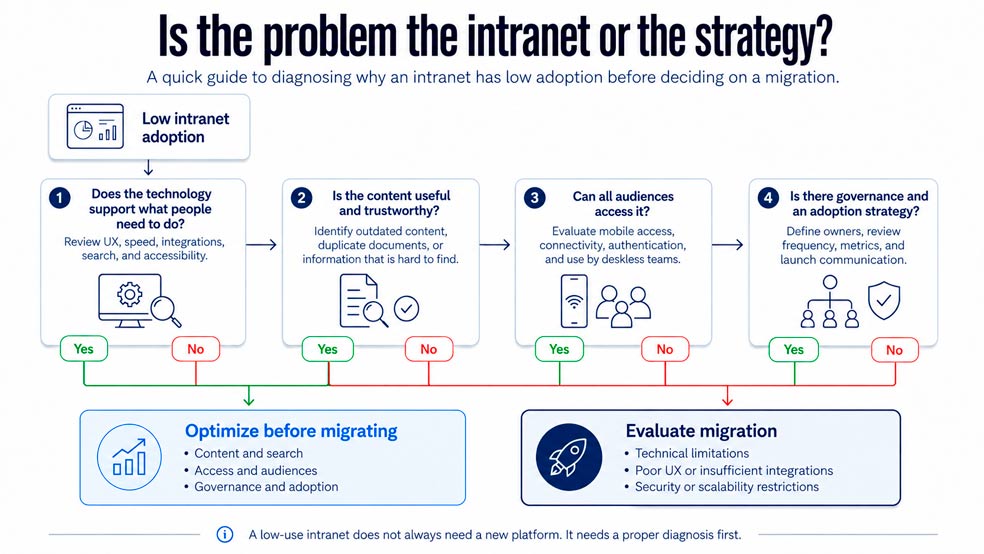
When Should an Organization Migrate Its Intranet?
Organizations should consider intranet migration when technical, integration, security, accessibility, or user-experience limitations cannot reasonably be resolved within the existing platform.
By contrast, if the main problem is outdated content, weak governance, low relevance, or an ineffective adoption strategy, a new tool may reproduce exactly the same pattern.
Before investing in migration, separate two questions:
- What is failing in the technology?
- What is failing in the way the organization manages and communicates the intranet?
The answer helps distinguish when the existing platform should be optimized and when evaluating a migration actually makes sense.
How to Improve Intranet Adoption Before Changing Platforms
Learning how to improve intranet adoption starts with restoring the platform’s usefulness and reliability: prioritizing relevant content, making information easier to find, adapting access to different audiences, and establishing clear ownership.
It is also important to understand the intranet’s role within the broader communication-channel ecosystem.
As we explore in our article on internal communication platforms, adding more technology does not automatically create a better employee experience.
Migration may be part of the solution. But diagnosing the problem first makes it easier to decide what should stay, what should change, and what the organization actually needs from a new intranet.
At Oxean, we help organizations diagnose why their digital communication channels lose adoption and define content, adoption, and governance strategies before deciding whether to migrate.