
A lack of internal communication team capacity appears when demands grow and the team no longer has the time, resources, or skills required to respond with the depth the organization needs.
That does not necessarily mean the team lacks talent. An overloaded internal communications team may know exactly what needs to be done and still lack the capacity to sustain strategy, production, and measurement at the same time.
When a team can no longer keep up, adding people is one option—but it is not the only one. The problem may come from temporary peaks in demand, skills that are not currently available in-house, or an operation that consumes too much time. That is why the key question is: does the team need more people, or does it need more capacity?
When Internal Communication Team Capacity Becomes a Problem
A team’s capacity does not depend solely on how many people are on it.
It also depends on how much time can be devoted to strategic priorities, what expertise is available, and which resources can be activated when demand increases.
In practical terms, having enough capacity means being able to:
- think and plan, not just execute;
- access specialized skills when a project requires them;
- respond to workload peaks without turning urgency into the team’s normal operating model;
- measure results and learn from what has been done.
When Every Minute Counts
The broader context does not make things easier.
The IC Index 2026 from the Institute of Internal Communication (IoIC), based on 5,000 UK workers, found that most employees have 10 minutes or less per day to engage with corporate communication, while one in five say they have little or virtually no time to do so.
In this environment, increasing capacity should not simply mean producing more.
It means having the resources needed to make better decisions about what to communicate, to whom, in which format, at what time, and for what purpose.
These five signs can help identify when that moment has arrived.
1. Is Daily Urgency Pushing Strategy Aside?
One of the first signs appears when the Internal Communications team is constantly operating in reactive mode.
The agenda fills up with last-minute requests:
- presentation updates;
- announcements, newsletters, and posts for internal platforms;
- content for events;
- requests from different departments.
Everything seems important. And precisely because of that, it becomes difficult to distinguish what is truly strategic.
The problem begins when this dynamic leaves no room to work on more important questions: What do employees need to understand? Which messages should be prioritized? Which channels are working? Which cultural changes need support? How is leadership being perceived?
Strategic internal communication requires diagnosis, planning, and follow-up.
Without that space, a team can produce a great deal while generating very little impact.
The IC Index 2026 shows that only 54% of employees rate their organization’s communication as excellent, nine points lower than in 2025. The data does not prove that the decline is caused by limited team capacity, but it does reflect an environment in which effective communication requires organizations to reassess priorities, resources, and ways of working.
2. Do Workload Peaks Overwhelm the Team Again and Again?
Not every organization needs the same level of communications capacity throughout the year.
A merger, restructuring, leadership change, technology transformation, culture campaign, regional launch, or major event can temporarily multiply communication needs.
At those moments, the problem is not necessarily that the internal team is too small. The problem is that demand has changed abruptly.
One alternative is to keep the organization’s strategic knowledge in-house while bringing in an internal communications agency as an extension of the team to expand planning, creative, production, and execution capacity when needed.
This reflects the logic behind Oxean’s flexible-capacity model:
Add capacity to absorb more workflows without necessarily expanding the permanent structure, while keeping strategic judgment and the relationship with the business inside the organization.
The need to reassess resources is not simply a perception.
The Conference Board found that:
56% of Communications leaders believe they are well or very well equipped in terms of team size, skills, and talent to increase their business impact. By contrast, 21% consider themselves poorly equipped.
The question, then, is not simply how many people are on the team, but how much capacity the team actually has when demand changes.
3. Does Your Team Have Ideas but No Time to Innovate?
Another warning sign appears when innovation is always postponed.
The team knows it could experiment with new formats, improve audience segmentation, produce more audiovisual content, incorporate interactive experiences, or explore new ways to drive engagement.
But daily operations leave no room to do it.
Creativity needs capacity, too.
An Internal Communications strategy might combine:
- multi-format campaigns;
- videos and micro-content;
- podcasts and newsletters;
- gamification, activations, and events;
- content for intranets, apps, and collaborative platforms;
- artificial intelligence to accelerate selected processes.

The challenge is not adding new formats because they are trending. It is choosing the formats that best solve each communication need.
At Oxean, this approach is part of an Augmented Internal Communications model: senior expertise, supervised artificial intelligence, and flexible capacity work alongside the internal team to expand what it can accomplish without replacing it.
The distinction matters: More capacity should not simply translate into more production. It should increase the team's ability to turn business objectives into concepts, narratives, campaigns, and experiences.
4. Could AI Increase Capacity—but the Team Lacks the Time or Expertise to Implement It?
Artificial intelligence can free up capacity within an Internal Communications team, but implementing it effectively also requires strategy, testing, usage guidelines, and human oversight.
This creates a paradox.
When a team is already overloaded, it may lack exactly the time it needs to discover how AI could help it work more effectively.
When properly integrated, AI can help teams:
- summarize and organize information;
- generate first drafts of content;
- adapt messages for different audiences and channels;
- accelerate repetitive tasks;
- free up time for higher-value strategic work.
But access to technology alone is not enough.
An IBM 2025 CEO study found that only 16% of AI initiatives had scaled enterprise-wide, while 50% of surveyed CEOs acknowledged that the pace of recent investment had resulted in disconnected technology across their organizations.
The question for Internal Communications, then, becomes:
Is the team using AI to recover capacity—or trying to add AI on top of an operation that is already overloaded?
Strategic judgment, cultural understanding, and final review still require people.
That is why AI applied to internal communication creates more value when it is integrated into clear processes and objectives rather than introduced as an isolated tool.
5. Does Operational Work Take So Much Time That Measuring Impact Gets Pushed Aside?
A final warning sign appears when the team manages to produce and publish content, but measurement is always postponed.
Open rates, views, and clicks provide useful information.
However, an Internal Communications strategy also needs to answer other questions:
- Did employees understand the message?
- Did a perception change?
- Did participation increase?
- Was a new tool adopted?
- Are leaders communicating consistently?
- Did the organization support a change process more effectively?
The IC Index 2026 provides another important signal: only 49% of employees agree that the reasons behind organizational changes are communicated clearly.
An Internal Communication Assessment can help identify gaps in understanding, perception, and adoption—and turn that information into better decisions.
If production permanently consumes all available resources and prevents the team from closing the cycle between strategy → execution → measurement → improvement, then capacity is also part of the problem.
More People or More Capacity? How to Decide
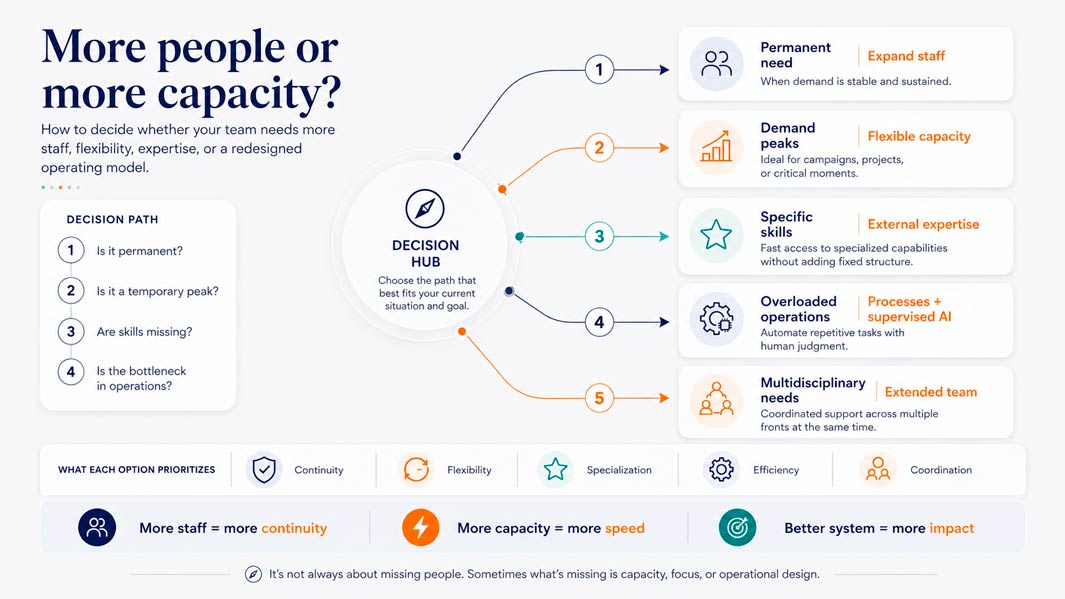
The answer is not always to hire.
Before expanding the permanent structure, it is worth identifying what is actually creating the bottleneck.
Increasing internal communications team capacity can mean hiring new people, adding external expertise, activating flexible capacity, or redesigning processes.
A stable, permanent requirement is not the same as a temporary demand spike, the absence of a specialized skill, or an operation that spends too much time on repetitive work.
When Does It Make Sense to Expand the Internal Team?
Adding a new role can make sense when there is a stable, recurring, and strategic function that the organization needs to maintain internally over the long term.
In that scenario, adding headcount addresses a structural need, rather than simply responding to a temporary period of higher demand.
How to Increase Internal Communications Capacity Without Hiring
When needs change from month to month, production peaks are temporary, or specific capabilities are required but do not justify a permanent hire, other alternatives are available.
A simple way to assess the situation is to identify the type of need involved.
| If the problem is... | Consider... |
|---|---|
| A permanent, stable need | → Expanding the internal team |
| Temporary peaks in demand | → Adding flexible capacity |
| Specific skills are missing | → Bringing in specialized expertise |
| Operations consume too much time | → Reviewing processes, automation, and supervised AI |
| Several capabilities are needed at the same time | → Considering a multidisciplinary external team |
The goal should not simply be to do more.
It should be to restore the balance between strategic thinking, high-quality production, responsiveness to change, measurement, and continuous improvement.
When a team is constantly forced to choose between solving urgent requests and doing the strategic work the organization actually needs, it may be time to increase its capacity.
More Capacity Does Not Mean Replacing the Internal Team
At Oxean, this approach is reflected in an Augmented Internal Communications model that combines senior human expertise, supervised artificial intelligence, and flexible capacity to integrate with the internal team whenever demand requires it.
The model is designed specifically to absorb more workflows without necessarily expanding the permanent structure.
Increasing Internal Communications capacity is not simply about producing more. It means creating more capacity to think, create, support change, and generate impact.
FAQ – Frequently Asked Questions
What does a lack of capacity in Internal Communications mean?
A lack of capacity in Internal Communications occurs when demands exceed the team's available time, resources, or skills. It does not necessarily mean a lack of talent: a team may know exactly what needs to be done but still lack the capacity to sustain strategy, production, execution, and measurement at the same time.
How can you tell if an Internal Communications team is overloaded?
A clear sign is when daily urgency consistently pushes strategic work aside. If the team spends most of its time responding to last-minute requests, producing communication materials, and handling operational tasks while postponing planning, innovation, analysis, or measurement, there is likely a capacity problem.
When does it make sense to expand the Internal Communications team?
Expanding the team makes sense when the additional demand is stable, recurring, and strategic, and requires capabilities the organization will need to sustain over the long term. Before increasing permanent headcount, it is important to distinguish between an ongoing need and temporary workload peaks that can be addressed in other ways.
How do you know when internal communication team capacity has become a problem?
Internal communication team capacity becomes a problem when the team can no longer balance strategic planning, content production, measurement, and unexpected demands without constantly working in reactive mode. Other signs include recurring workload peaks, limited time for innovation, missing specialized skills, and measurement being repeatedly postponed.
What can an agency contribute as an extension of the internal team?
An agency can provide flexible capacity, specialized expertise, and speed without requiring a permanent expansion of the internal structure. It can support the team with strategy, creativity, content, design, production, and execution during demand peaks or specific projects, while the internal team retains organizational knowledge and its connection to the business.