
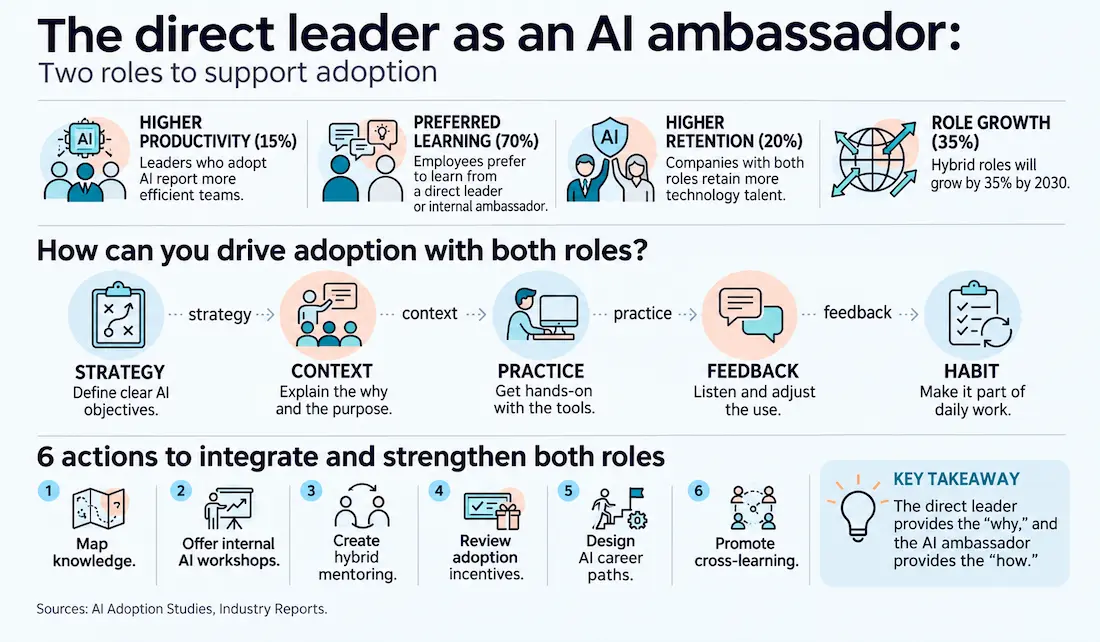
Direct managers and AI ambassadors can speed up artificial intelligence adoption because they turn a corporate strategy into examples, answers, and habits that apply to everyday work. Managers bring context and legitimacy; ambassadors add closeness, experimentation, and peer learning.
That said, neither role works on its own. For them to truly help change behaviors, Internal Communication needs to prepare them with messages, use cases, guidelines, and feedback channels.
Why are direct managers and AI ambassadors key to adoption?
AI adoption doesn’t depend solely on having tools available or launching training programs. It also takes people close to the work who explain what the technology is for, show how to apply it, and support the questions that come up during real use.
The Employee Communication Impact Study 2025 from Staffbase found that the immediate supervisor is the information source employees trust most: 57% said they trust that channel “a great deal,” more than intranets, management communications, newsletters, and internal apps. At the same time, AI at Work 2026 from BCG, based on 11,749 workers in 14 markets, shows a significant gap: 72% say the skills they need for their work are changing, but only 36% feel they’ve received enough training. Among frontline workers, only about a third find leaders’ communication about AI clear.
That’s why communicating AI isn’t just about explaining a tool: it means translating the change into the context of each team.
Why is the direct manager a key Internal Communication channel?
A direct manager has an advantage that’s hard to replicate with a corporate announcement: they know their team’s tasks, priorities, and specific concerns.
They can explain:
- what’s changing;
- why it matters;
- what’s expected of each person;
- where AI can be used;
- what limits or guidelines apply.
They can also connect a company-wide decision to a specific situation in daily work.
But that closeness doesn’t guarantee good communication. If managers don’t get context, talking points, and answers to predictable questions, they can quickly become another source of uncertainty.
What is an AI ambassador, and how do they differ from a formal leader?
An AI ambassador, also known as an AI champion, is an internal go-to person who experiments with tools, shares use cases, and helps colleagues bring artificial intelligence into their work. Their influence comes more from their experience and credibility among peers than from hierarchical authority.
BCG describes AI champions as early adopters who test tools, integrate them into real workflows, and share what they learn with other teams. The consulting firm notes that these go-to people can accelerate adoption among peers, and it recommends activating managers as multipliers too.
What sets an AI ambassador apart?
In general, AI ambassadors:
- don’t need hierarchical authority to be heard;
- stay close to the everyday problems of their area;
- test use cases before scaling them;
- spot early resistance and doubts;
- translate technical concepts into the team’s language;
- carry feedback from users back to the people managing the transformation.
That’s why identifying these go-to people takes something close to audience segmentation: it’s not enough to pick whoever knows the most about technology; you need to recognize who has legitimacy, the ability to explain, and the willingness to help others.
That criterion connects directly to the work of segmentation and storytelling in internal communication.
Why can a network of AI ambassadors speed up adoption?
A network of AI ambassadors brings learning closer to the real work context. Instead of relying only on general instructions, each team has a go-to person who can show how to apply AI to specific problems.
McKinsey cites Harvard Business Review research showing that 55% of employees turn to their peers first when they need to learn something new. The firm highlights peer learning as a way to expand capabilities and turn early teams into internal multipliers. McKinsey & Company
BCG reaches a similar conclusion: companies that make it easy to ask everyday questions about integrating AI into work, and that offer incentives for champions to share their techniques, have seen improvements in adoption.
What does an AI ambassador offer that formal training doesn’t cover?
Training can provide a common foundation. Ambassadors add continuity.
They can:
- show a case applied to a real task;
- answer a question when it comes up;
- share a prompt, workflow, or practice they’ve already tested;
- adapt what’s learned to their area’s vocabulary;
- spot where the tool creates friction;
- show results from colleagues who’ve already adopted it.
That’s why it makes no sense to pit ambassadors against training. They work best as complementary layers: training establishes baseline skills, and the network of go-to people helps turn them into habits.
How do you prepare leaders and ambassadors to communicate AI?
Preparing leaders and ambassadors means giving them useful information before asking them to communicate: context, key messages, use cases, answers to objections, and a clear path for feeding back what they hear on their teams.
What does a direct manager need?
Internal Communication can provide them with:
- a short core message: what’s changing and why;
- impact on their team: what specifically changes;
- expected action: what each person should do next;
- frequently asked questions: doubts, risks, and limits;
- responsible use guidelines: what’s allowed and what isn’t;
- escalation channel: where to take questions they can’t answer.
As we explain in our guide to effective internal messages, if the expected action isn’t clear, the message loses its power to drive behavior.
What does a network of AI ambassadors need?
Ambassadors need more than an appointment:
- early access to tools and updates;
- prioritized use cases;
- recognized time within their workday;
- spaces to exchange learnings;
- contact with IT, People, and Internal Communication;
- visible recognition;
- a loop for sharing feedback and detecting needs.
The network also needs coordination. Without it, it can become a group of enthusiasts who experiment separately but never build reusable knowledge.
This is where an internal communication and change management strategy can turn isolated go-to people into a network with goals, messages, rituals, and follow-up.
Oxean works precisely with networks of go-to people, internal champions, leadership, AI adoption, and organizational transformation as part of its internal communication services.
How do you measure whether leaders and ambassadors are driving AI adoption?
Measuring a network of leaders and ambassadors shouldn’t stop at counting training sessions or communications sent. The goal is to see whether useful AI use is growing and whether people find the support they need to bring it into their work.
It’s worth tracking indicators such as:
- employees who use the tools regularly;
- use cases shared and reused;
- questions or problems solved by the network;
- participation in learning spaces;
- how doubts and resistance evolve;
- perceived clarity about AI use;
- continued use after the initial training.
That way, leaders and ambassadors stop being just “spokespeople” and become part of a continuous adoption and learning system.
How can Internal Communication sustain a network of AI ambassadors?
Internal Communication connects leaders and AI ambassadors to keep a consistent narrative, collect questions, share learnings, and sustain adoption over time.
As we explored in our piece on the new role of the internal communicator in the face of artificial intelligence, supporting adoption means listening to doubts, communicating answers, and connecting the integration of AI to culture and business goals.
At Oxean, we help organizations identify go-to people, prepare leaders, design networks of champions, and build Internal Communication strategies to support change and technology adoption processes.