
Choosing between a full campaign and a simple message depends on the objective, not on how many pieces a team can produce. Internal communication campaign vs. announcement? A campaign makes sense when a message needs to change behavior, remain relevant over time, or adapt to different audiences. For a specific, clear, and actionable update, a simple announcement is usually enough.
The problem begins when everything becomes a campaign. Formats, channels, and repetition increase, but understanding does not necessarily improve. These four mistakes can help teams decide when to expand a communication—and when to simplify it.
Why doesn’t every message need an internal communication campaign?
When every announcement is treated like a campaign, message volume increases and employees have a harder time recognizing what requires attention, what is urgent, and what can be resolved with one clear communication.
According to the 2025 International Employee Communication Impact Study from Staffbase and YouGov, based on 3,574 employees across six countries, only 43% were satisfied with the amount of internal corporate communication they received and 42% with its quality.
The same study found a strong connection between communication clarity and perceived quality: among employees who said their organization’s vision and strategy were easy to understand, 78% rated internal communication as excellent or very good. Among those who felt that vision and strategy were not communicated effectively, that figure dropped to just 3%.
The IC Index 2025, based on 4,939 UK workers at organizations with 500 employees or more, found that 74% believed they received the right amount of internal communication, while 14% said they received too much.
Among employees who believed they received the right amount, 75% rated their organization’s communication as excellent. Among those who felt they received too much communication, that figure fell to 42%.
Internal communication campaign vs. announcement: 4 mistakes to avoid
Mistake 1: turning an operational notice into an internal communication campaign
A schedule change, deadline, or specific operational update does not always need its own identity, multiple pieces, and a full communication calendar.
Before producing anything, ask:
- Does the audience already have the necessary context?
- Is there one clear action?
- Does the message need to remain visible over time?
- Could one communication solve the need?
Si lo único que importa es que el mensaje llegue al público, se entienda y desencadene una acción específica, probablemente baste con un simple anuncio.
This gives the internal communication team greater speed and prevents unnecessary noise.
Mistake 2: using multiple channels without adding value
Another common mistake is sending the same idea through email, banners, video, intranet, and collaborative platforms without giving each format a distinct role.
The 2026 State of Workplace Communication survey from Reworked and Korbyt, conducted in partnership with ICology among 1,175 full-time U.S. employees, found that 46% tune out when messages feel repetitive across channels.
Each additional piece should therefore serve a specific purpose:
- anticipate;
- explain;
- go deeper;
- remind;
- make an action easier.
This repetition is also closely related to workplace information overload: when every message appears across every channel, employees have a harder time identifying priorities and finding relevant information.
Mistake 3: launching a campaign just to show activity
Sometimes a campaign starts from the needs of the communication team rather than the needs of the audience.
The process begins with ideas such as:
“Let’s do something big.”
“We need more impact.”
“Let’s refresh the visual identity.”
Only afterward does the team try to justify what problem the campaign is supposed to solve.
Some warning signs are easy to recognize:
- the format was decided before the objective;
- the number of pieces was defined before analyzing the need;
- the campaign exists because it is already on the calendar;
- it is difficult to explain what employees should know, think, or do after seeing it.
Creativity matters. But creativity should be the response to a communication problem—not the starting point.
When this pattern appears across different teams or channels, strategic internal communication consulting can help prioritize needs, review communication flows, and decide where resources should actually be focused.
Mistake 4: treating ongoing change as if it ended with the campaign
Here the problem is different. The campaign may actually be necessary—but the organization expects it to do all the work.
As we explain in our article about common mistakes in organizational culture change, a campaign can introduce a narrative and create visibility, but it cannot change a culture or behavior on its own.
After launch, organizations still need:
- visible leadership;
- conversations;
- employee listening;
- follow-up;
- reinforcement;
- decisions that are consistent with the message.
That is why a campaign supporting organizational change should not end when the communication calendar ends.
The campaign is one stage in a broader process.
When to use an internal communication campaign
An internal communication campaign makes sense when the objective needs to be sustained over time, mobilize a behavior, address different audiences, or reinforce a message progressively. A simple announcement is usually enough when the information is specific, clear, and immediately actionable.
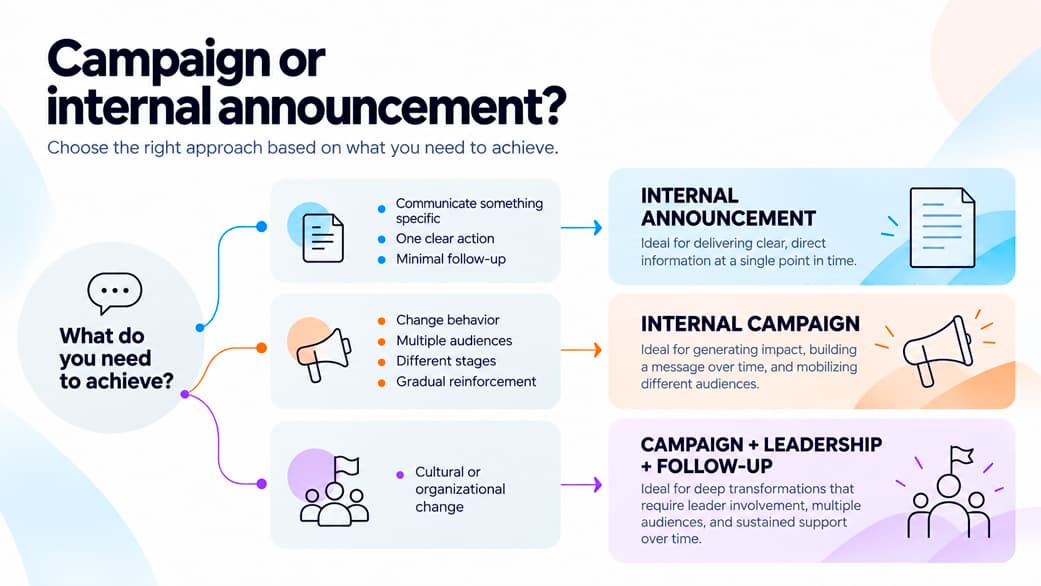
When does an internal campaign make sense?
A campaign is more appropriate when:
- the goal is to introduce or change a behavior;
- different audiences have different communication needs;
- the topic develops in stages;
- the idea needs reinforcement at different moments;
- each format can serve a different purpose;
- follow-up is planned after launch.
If a campaign is genuinely necessary, then it makes sense to work on the concept, narrative, phases, formats, and measurement.
Our guide on how to design internal communication campaigns with impact and creativity focuses precisely on that next stage: what to do once you have already decided that a campaign is the right answer.
When is a simple internal announcement enough?
A simple announcement is usually enough when:
- the message is operational or specific;
- the audience already understands the context;
- there is one clear action;
- the topic does not need to remain active for several weeks;
additional formats would simply repeat the same information.
Choosing a simple announcement does not mean communicating with less quality.
As we explain in our article on effective internal messages, the objective is to help employees quickly recognize what is changing, why it matters, and what they need to do.
How to choose between an internal communication campaign and an announcement
Before producing content, a simple decision sequence can help:
- Define what you want to achieve. Informing employees does not require the same level of communication as changing behavior.
- Identify what the audience needs. More pieces will not necessarily solve a lack of clarity.
- Determine how long the message needs to remain active. A one-time need and an organizational change process require different approaches.
- Give each channel a clear role. If every channel does the same thing, there are probably too many pieces.
- Decide what you will measure. Reach, understanding, participation, or behavior should connect directly to the original objective.
This approach shifts the question from: “What can we produce?” to a more strategic one: “What does this communication actually need in order to work?”
From producing more to choosing better
Not everything needs to become a campaign. When every communication receives the same level of production, the campaigns that truly matter become harder to distinguish.
The challenge for internal communication teams is not to produce more, but to decide what each message actually needs.
Sometimes that means a full campaign. Other times, a clear announcement sent to the right audience through the right channel is enough.
At Oxean, we help organizations organize their internal communication, define priorities, and turn business needs into strategies, campaigns, and content with a clear purpose.