
Digital adoption for frontline workers works when information and digital tools are adapted to the realities of employees working on the plant floor.
At Oxean, after more than three decades of designing internal communications strategies, we know that launching an app is not enough. Adoption depends on making access simple, involving frontline supervisors, and giving employees a concrete reason to use the tool.
That is why internal communications for plant employees need to start with how people actually work—not with the features of the platform.
Why Is Digital Adoption Harder for Frontline Workers?
assumptions is introduced without adapting access, content, and the user experience to the realities of plant-floor work.
For years, many internal platforms were designed around individual computers and corporate email accounts.
However, a large share of the global workforce operates outside that model.
According to Boston Consulting Group (BCG), deskless workers represent approximately 70% to 80% of the global workforce—or about 2.7 billion people who do not normally work at a desk.
Before interpreting low adoption as resistance to change, organizations should review:
- Access: Do employees have a device or access point available?
- Connectivity: Can they connect during their workday?
- Authentication: Does access require a corporate email account or too many steps?
- Usefulness: Does the platform solve a real need?
- Content: Is information adapted to the time and context of plant-floor work?
- Leadership: Do supervisors understand and use the tool themselves?
The strategy should begin by understanding how plant employees actually work, not by reviewing the platform’s list of features.
What Are the Benefits of Successful Digital Adoption on the Plant Floor?
A well-adopted digital platform can expand access to information, safety updates, benefits, and opportunities to participate—particularly among employees who do not regularly use traditional corporate channels.
When adoption works, potential benefits include:
- better access to information across shifts and locations;
- faster communication of operational or safety updates;
- greater participation in internal initiatives;
- simpler access to benefits and corporate content;
- more opportunities for employee listening and feedback;
- a stronger connection between frontline teams and the organization.
However, that does not mean a platform creates engagement by itself.
Gallup’s State of the Global Workplace 2026 reports that 20% of employees worldwide were engaged at work in 2025.
Technology can improve access to information, but engagement also depends on leadership, employee experience, recognition, and trust.
5 Ways to Improve Digital Adoption for Frontline Workers
Digital adoption improves when access is simple, content provides immediate value, and frontline leaders actively participate in the process.
There is no universal formula, but five decisions can significantly improve adoption.

1. Design for Real Access, Not for the Desk
Frontline workers need to access information through the devices and access points that actually fit their workday.
For some organizations, that may mean a mobile app. For others, it may involve shared devices, QR codes, digital kiosks, screens, or a combination of channels.
The key is to prevent corporate email, individual computers, or complex authentication processes from becoming barriers to entry.
As we explained in our guide to intranet adoption, a platform can function perfectly from a technical standpoint while still excluding part of the workforce.
2. Involve Supervisors and Frontline Champions from the Beginning
Frontline and shift supervisors remain among the most important points of contact between employees and the organization.
They should be trained before launch, involved in testing, and understand not only how the platform works, but also what problem it is meant to solve.
The logic is consistent with any change management process focused on adoption: local leaders and champions can identify barriers, answer questions, and help turn a new tool into part of employees’ everyday routine.
3. Give Employees a Reason to Come Back
Posters, demonstrations, QR codes, or incentives can help drive the first login.
But there is an important distinction:
The launch drives the first login. Value drives the next one.
To sustain usage, the platform should help employees address concrete needs, such as:
- checking shift or plant updates;
- accessing safety information;
- reviewing benefits;
- completing internal requests or processes;
- participating in recognition programs;
- finding useful procedures or documentation;
- sending feedback.
Incentives can support initial activation, but they should not become the only reason employees return.
4. Combine Digital Communications with In-Person Moments
Digital adoption does not mean eliminating face-to-face communication.
In fact, a digital platform can be more effective when it complements shift meetings, onboarding sessions, training, bulletin boards, safety briefings, and conversations with supervisors.
Organizations may also benefit from starting with a pilot at one plant, identifying barriers, and refining the model before scaling it across other locations.
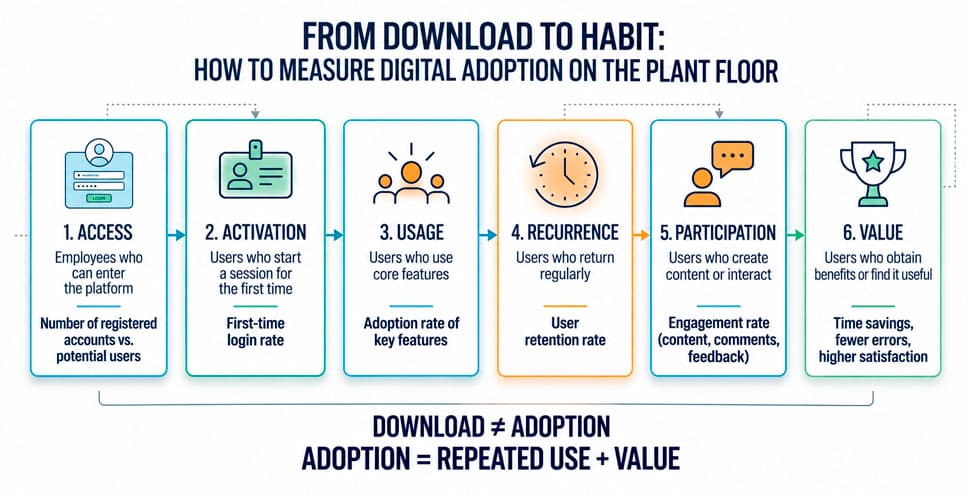
5. Measure Real Adoption, Not Just Downloads
Downloading an app does not mean adopting it.
To understand whether a tool is becoming part of employees’ routine, organizations should track the entire adoption journey:
| Stage | What to Measure |
|---|---|
| Access | Employees who can access the platform |
| Activation | First login or registration |
| Usage | Active users |
| Retention | Return frequency |
| Participation | Actions, responses, or inquiries |
| Value | Tasks or needs successfully resolved |
As we explain in our guide on how to measure Internal Communications effectiveness, a metric becomes useful when it is connected to the objective the organization is trying to achieve.
What Challenges Affect Digital Adoption in Mining, Energy, and Agribusiness?
Connectivity, shift patterns, and geographic dispersion mean that digital adoption for frontline workers needs to be adapted to the realities of each operation.
Mining
Mining operations often combine remote sites, long shifts, and unique connectivity constraints.
McKinsey analyzed 140 analytics implementations and found that involving experts and frontline users was one of the factors associated with successful adoption.
Some of the cases analyzed achieved 10% to 15% higher production, while another reduced fuel costs by 15%.
These results refer specifically to analytics solutions rather than internal communications platforms, but they illustrate a broader principle:
technology adoption improves when the people expected to use the technology are involved in its implementation.
Energy
In the energy sector, plants, wells, and generation sites are often located in remote areas, with employees rotating across sites and shifts.
In these environments, face-to-face communication often remains central to everyday work.
A digital platform therefore needs to complement established communication routines rather than assume they will disappear.
Agribusiness
The International Telecommunication Union (ITU) continues to report a significant gap between urban and rural Internet access.
In 2025, 85% of people living in urban areas used the Internet, compared with 58% of people in rural areas.
Across all three sectors, the underlying principle is the same: adapt the technology to the operating context, involve frontline leaders, and avoid designing a digital channel around conditions that part of the workforce cannot meet.
When Do Internal Communications for Plant Employees Need a Digital Adoption Strategy?
Digital adoption should be treated as an internal communications project when multiple plants, shifts, channels, or employee audiences are involved and the problem cannot be solved through technology or training alone.
Some warning signs include:
- low activation after launch;
- employees who log in once and never return;
- employees without direct access to corporate channels;
- excessive dependence on supervisors to relay information;
- significant differences in adoption between plants or shifts;
- difficulty measuring whether the platform has actually become part of employees’ routine.
At Oxean, we address these challenges through our Internal Communications services, combining diagnosis, strategy, change management, implementation, and measurement.
Digital Adoption for Frontline Workers Does Not Start with Technology
A digital platform can make information easier to access, but adoption depends on the experience built around it.
Reducing friction, involving frontline leaders, combining digital and in-person communications, and measuring recurring use are what turn a launch into a habit.
That is why, instead of asking:
“How many people downloaded the platform?”
organizations should ask:
“How many employees found enough value to come back and
At Oxean, as a corporate communications agency specializing in internal and external communications, we help global companies design digital adoption strategies tailored to each plant, workforce, and operating environment.