
Senior talent in the age of AI can become a competitive advantage when experience is paired with up-to-date technology skills. AI speeds up tasks and processing; professionals with long track records bring context, judgment, business knowledge, and accumulated learning.
In this article, senior talent refers to professionals age 50 and older with an established career. The problem appears when workplace ageism shuts them out of opportunities just when companies need to retain critical knowledge.
Why does senior talent gain value in the age of AI?
Artificial intelligence doesn’t eliminate the value of experience: it changes where that experience is most useful. As certain tasks are automated or accelerated, it becomes more important to interpret results, spot risks, understand context, and decide what to do with the information.
The OECD has documented productivity benefits associated with the complementarity between workers of different ages. The challenge isn’t choosing between experience and technology, but getting both capabilities to work together.
Experience and artificial intelligence: complementary capabilities
A senior professional can bring:
- judgment in ambiguous situations;
- institutional memory of past decisions and experiences;
- deep knowledge of the business and its customers;
- the ability to anticipate risks;
- the experience to question an AI answer that looks right but doesn’t fit the context.
This doesn’t mean experience is infallible or that keeping up with technology no longer matters. As we discussed in our article on human judgment in internal communication, the greatest potential appears when technology and experience complement each other instead of competing.
Why is workplace ageism a business problem?
Workplace ageism can lead a company to lose experience, knowledge, and the ability to pass it on before it has even assessed the real value of those professionals.
According to the World Health Organization, one in two people worldwide holds ageist attitudes. The bias can show up in hiring, but also in promotions, training, professional development, and everyday conversations.
ECLAC, the UN Economic Commission for Latin America and the Caribbean, projects that by 2050 people age 60 and older will make up about 25.1% of the region’s population.
Therefore, excluding professionals because of their age is not only an inclusion issue. It also shrinks the pool of available talent in an aging labor market.
Where does bias against senior professionals show up?
Ageism isn’t limited to hiring. It can also appear when:
- certain groups are left out of technology training;
- innovation is associated exclusively with youth;
- senior profiles disappear from internal communications;
- development opportunities are concentrated in the early stages of a career;
- resistance to change is assumed before the person is evaluated.
From an internal communication standpoint, one signal is especially visible: how the organization represents innovation. If campaigns about AI, transformation, or the future consistently feature only young people, communication can reinforce a cultural bias even when no policy states it.

In our article on hiring senior talent, we already looked at the opportunities of bringing these professionals on board.
The question here is different: what does an organization lose when it doesn’t develop that capital in a context shaped by AI and technological transformation?
What are the benefits of a multigenerational team?
Multigenerational teams combine experience, new skills, and different perspectives on the same problem. Their value doesn’t come from pitting generations against each other, but from drawing on how they complement one another.
The OECD notes that greater age diversity can produce productivity benefits when younger and older workers share knowledge and skills.
In Argentina, the management of senior talent is also starting to be measured specifically. For its 2026 Generación Silver (Silver Generation) ranking, Great Place to Work Argentina analyzed 63 organizations and looked specifically at the work experience of employees age 55 and older (report in Spanish).
In practice, that combination can foster:
- transfer of critical knowledge, even knowledge that was never documented;
- two-way mentoring;
- decisions informed by different perspectives;
- greater continuity through change or crisis;
- a better understanding of customers and audiences of different ages.
As we explored in our article on senior talent in the workplace, the challenge is to build a culture where different generations can contribute without being boxed in by stereotypes.
¿Cómo retener y potenciar el talento senior frente a la IA?
Retener y potenciar el talento senior frente a la IA requiere trabajar sobre tres frentes: conservar conocimiento crítico, garantizar acceso a nuevas habilidades tecnológicas y crear mecanismos de transferencia entre generaciones.
1. Mapea el conocimiento crítico
Identifica puestos donde una salida podría llevarse experiencia difícil de reemplazar:
- relaciones clave
- procesos no documentados,
- antecedentes de decisiones,
- aprendizajes de crisis o conocimiento técnico.
Después, planifica la transferencia antes de que aparezca la urgencia.
2. Incluye al talento senior en la capacitación en IA
La actualización tecnológica no debería detenerse después de determinada edad. Si la formación en IA se concentra únicamente en quienes ya tienen mayor afinidad digital, la empresa puede ampliar la brecha que intenta cerrar.
3. Diseña mentorías en dos direcciones
Los perfiles senior pueden aportar experiencia, contexto y conocimiento del negocio; otros integrantes pueden acercar nuevas herramientas, automatización y formas diferentes de resolver tareas.
La transferencia funciona mejor cuando circula en ambos sentidos.
4. Revisa cómo comunica la empresa la edad y la innovación
Las imágenes, historias, reconocimientos y ejemplos internos también indican a quién considera relevante la organización. Por eso, conviene revisar si innovación, transformación e IA incluyen realmente a distintas generaciones.
Una estrategia de Comunicación Interna puede ayudar a detectar esos sesgos, revisar mensajes y acompañar procesos intergeneracionales sin reducirlos a una campaña puntual.
5. Diseña transiciones de carrera
Roles de asesoramiento, mentoría, jornadas flexibles o esquemas progresivos pueden ayudar a conservar conocimiento y adaptar el vínculo laboral a distintos momentos profesionales.
6. Mide inclusión y aprendizaje por edad
Las métricas generales pueden ocultar diferencias. Conviene observar acceso a capacitación, movilidad interna, promociones, participación en innovación, pertenencia e intención de permanencia.
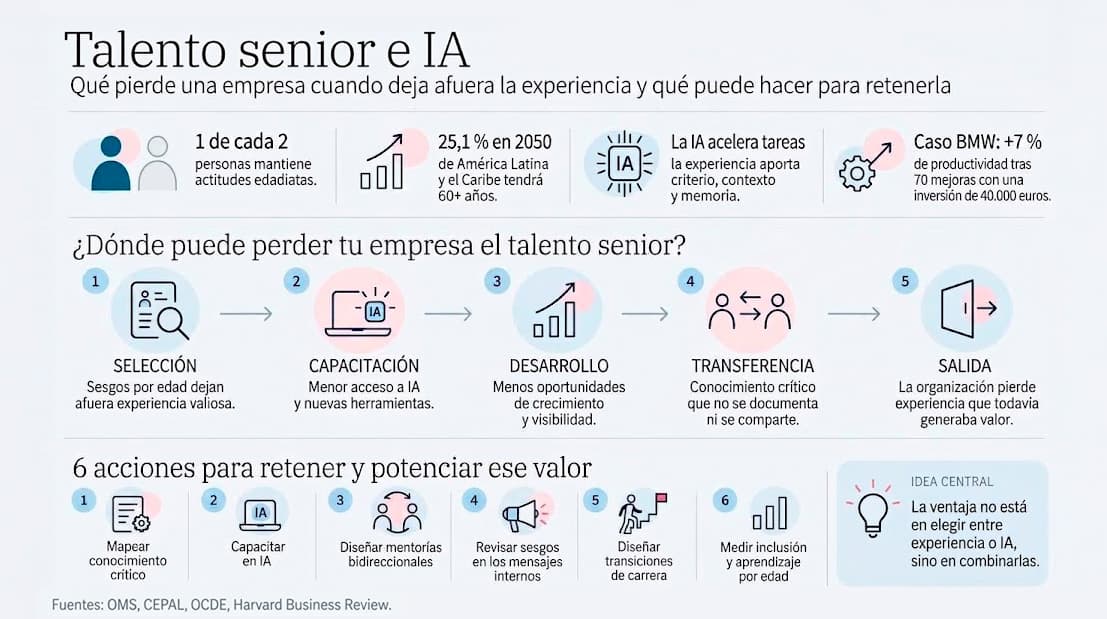
Caso BMW: escuchar al talento senior también puede mejorar la productividad
En 2007, BMW creó en su planta de Dingolfing, Alemania, una línea piloto con una edad promedio de 47 años, similar a la proyectada para el conjunto de la planta una década después.
Según el caso documentado por Harvard Business Review en 2010, los trabajadores participaron directamente en la identificación de mejoras.
Se implementaron alrededor de 70 cambios, desde ajustes ergonómicos hasta modificaciones en pantallas y puestos de trabajo. La inversión rondó los 40.000 euros y la productividad aumentó un 7 % en un año.
El aprendizaje sigue siendo relevante: la respuesta no consistió en reemplazar a las personas por su edad, sino en escucharlas y adaptar las condiciones para que pudieran aportar mejor.
El talento senior como ventaja competitiva, no como etapa final
En un escenario atravesado por IA, envejecimiento poblacional y transformación permanente, la pregunta más útil ya no es cuánto tiempo le queda a una persona dentro de la organización, sino cómo aprovechar su experiencia mientras sigue aprendiendo y transfiriendo conocimiento.
Reducir el edadismo, ampliar el acceso a nuevas herramientas y facilitar la colaboración entre generaciones permite convertir años de experiencia en capacidad organizacional.
En Oxean acompañamos a las organizaciones a trabajar estos desafíos desde la Comunicación Interna, la cultura, el liderazgo y la gestión del cambio, conectando transformación tecnológica con las personas que tienen que hacerla posible.