
An internal communication channel audit lets you assess whether channels, messages, information flows, and audiences are working before you change the technology. Its goal is to tell whether the problem really lies in the tool or in the strategy, content, governance, or adoption.
That’s why it’s best to do it before migrating an intranet, launching an app, adding AI tools, or shutting down a channel. Changing the platform first can carry the same problems over to the new platform.
Why audit your channels before changing platforms?
Auditing channels before a migration shows what is driving low adoption and keeps a new tool from reproducing problems that weren’t technological.
According to Gartner‘s 2022 survey, 47% of digital workers struggled to find the information they needed to do their jobs. In addition, the average desk worker used 11 applications. Adding another tool, by itself, doesn’t solve the problem.
Nor do all audiences use channels the same way. As we explain in our guide to digital adoption for frontline workers, people who work on the plant floor, in shifts, or without a fixed desk have different access conditions than corporate teams.
Before changing the channel, you need to understand what's failing around it.
What should you review in an internal communication channel audit?
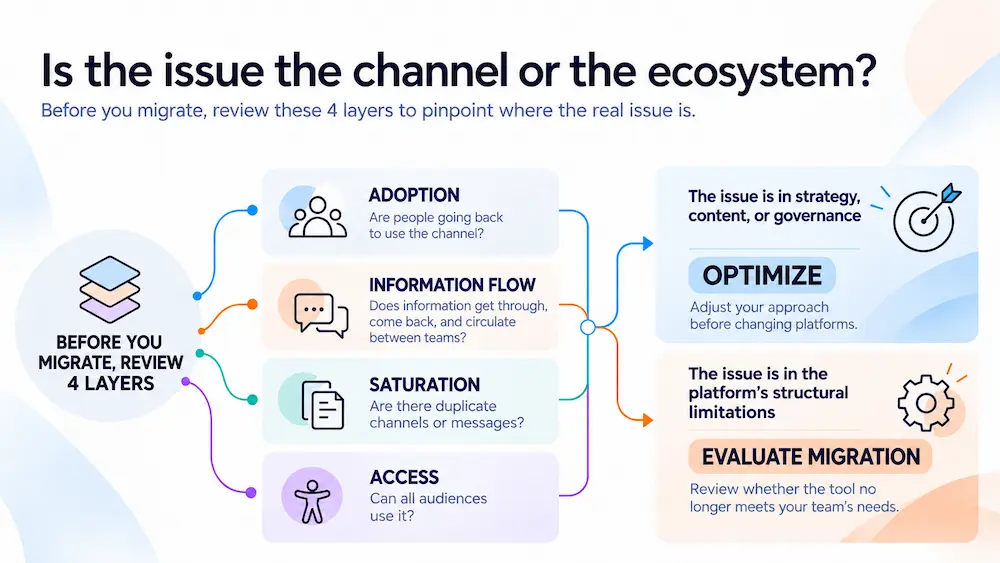
An internal communication channel audit should review at least four dimensions: actual adoption, information flows, channel overload, and access for different audiences.
1. Actual adoption vs. vanity metrics
An installed app or an opened email doesn’t prove the channel is meeting a need.
That’s why it helps to look at:- active users and repeat use, not just sign-ups or installs;
- time spent and reading depth;
- participation in surveys, replies, or comments;
- usage by site, department, shift, or employee type;
- tasks or needs that are actually resolved through the channel.
2. Information flows: where the message breaks down
Information moves top-down, bottom-up, and between peers. The audit has to detect where that path breaks.
It helps to review:- who creates and distributes the information;
- which leaders are involved;
- which audiences are left out;
- where delays or distortions appear;
- which informal channels replace the official ones.
3. Information fatigue and channel overload
More channels don’t equal better communication. When the same message appears by email, chat, intranet, and bulletin board, noise increases and it becomes less clear which source is official.
It helps to review:- how many messages each audience receives;
- how many actually apply to them;
- which channels serve similar functions;
- which content is duplicated;
- where each type of information should be looked for.
4. Access and digital maturity of internal audiences
Not everyone has the same devices, connectivity, habits, or digital skills.
That’s why, before changing channels, it’s worth assessing:- access to company devices;
- an available work email or digital identity;
- connectivity during the workday;
- habitual use of internal tools;
- accessibility needs;
- support needed during adoption.
Which KPIs should you use in an internal communication audit?
An audit’s KPIs should combine quantitative data with qualitative information. The numbers show where friction appears; conversations help explain why it happens.
Not every channel should be measured with the same indicator.
| Channel | Signal to watch | Audit question |
|---|---|---|
| Intranet | Low usage or visits only for administrative tasks | Does it meet everyday needs and make information easy to find? |
| Low open rates or too many sends | Does each audience receive relevant information? | |
| Internal chat | Noise and mixed conversations | Is it clear what should be communicated through this channel? |
| Bulletin board | Outdated information | Who updates it, and how often? |
| Internal app | Many installs, little repeat use | What value does the person find in coming back? |
| Leaders | Late or distorted messages | Do they receive the context and tools to communicate? |
What other sources should you include in the audit?
- short surveys;
- focus groups and interviews;
- frequent searches and searches with no results;
- arrival time of critical messages;
- stakeholder and influence maps;
- content and message analysis;
- usage data segmented by audience.
The goal isn't to produce a dashboard with more metrics, but to identify which decisions that data makes possible.
Challenges of an internal communication audit
Auditing has its obstacles too. The most common are:
- Conditioned responses. People may hold back criticism if they don’t feel their answers will stay confidential.
- Scattered data. Each channel measures differently.
- Internal resistance. Some areas may see the audit as an evaluation of their performance.
- Urgency to migrate. The pressure to launch a new tool can cut the diagnosis too short.
That’s why an outside perspective can bring objectivity and help integrate data, opinions, and needs from different areas.At Oxean, we approach this kind of diagnosis through strategic internal communication consulting, connecting channels, audiences, and change processes before defining a solution.
How do you move from an audit to a migration strategy?
An audit shouldn’t end in a report, but in decisions. The diagnosis has to show which problems can be solved by improving the current ecosystem and which truly justify a platform change.
It’s also worth considering change fatigue.Research by Gartner published in Harvard Business Review showed that the average employee went through 10 planned organizational changes in 2022, compared with two in 2016. Over that period, willingness to support those changes fell from 74% to 43%.That’s why a migration needs more than a technical schedule. These steps help organize the transition:
- Prioritize the findings. Start with the friction points that affect the most people or critical processes.
- Define the purpose of each channel. Every tool should have a recognizable function.
- Involve leaders and champions. They help translate the change into everyday work.
- Run a pilot. Test with one audience before scaling.
- Plan for coexistence. Avoid shutting down the old channel overnight.
- Measure again. Compare adoption, repeat use, and experience after launch.
When does it make sense to change channels?
Changing channels makes sense when there are limitations in access, integration, security, or experience that can’t be solved by improving content, segmentation, or governance.
By contrast, if the problem is irrelevant content, duplication, or a lack of owners, a new platform can repeat the same failures. As we explain in our article on intranet adoption, a channel with low usage doesn’t automatically mean the technology has failed.A practical tip: before migrating, ask people from different areas or shifts how they find out about news today and where they look for information when they need it. Those answers often reveal problems that no dashboard shows.Changing platforms without an audit means making a technology decision before understanding the communication problem. The audit helps you decide what to keep, what to fix, and what truly needs a new tool.
At Oxean, we support organizations from diagnosis through strategy, implementation, and change management, so that technology responds to a real communication need and not the other way around.