
No one doubts that improving organizational climate is essential for companies and organizations. however, many initiatives end up as well-intentioned proposals and messages that do not create a meaningful impact in day-to-day reality.
In this article, we explore this challenge and focus on concrete actions and effective strategies to improve organizational climate sustainably, while also protecting the business and the people behind it.
What is the current state of organizational climate worldwide?
Companies across regions and industries are struggling to achieve an optimal organizational climate. as a result, this situation has a direct impact on business performance.
Recent indicators on work climate
In an article published by Haz Revista, several worrying figures are highlighted:
- turnover reaches 24.1%.
- eNPS (employee net promoter score) drops to +17 points, showing lower employee loyalty and satisfaction.
- only 59% say they receive emotional support from the company.
- fewer than 65% feel their ideas are taken into account.
- only 73% feel comfortable expressing their opinion.
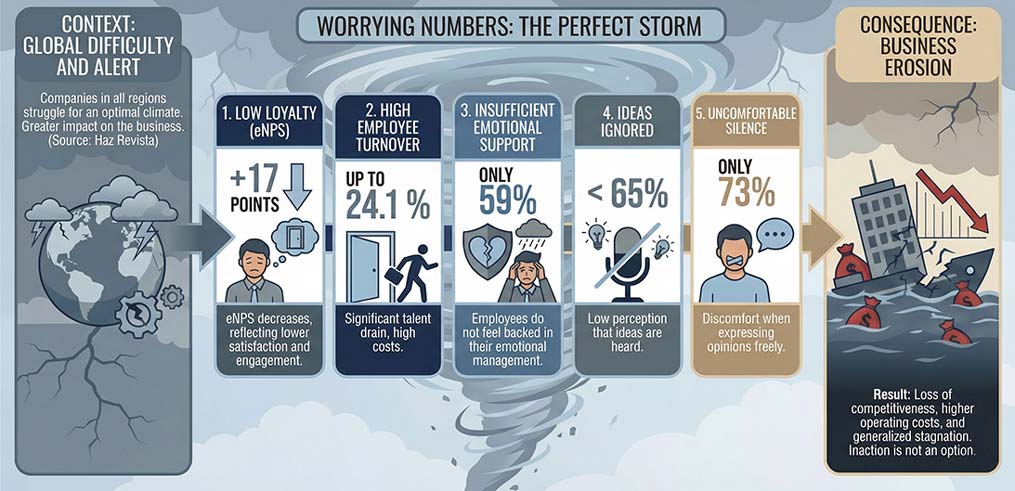
These are just some of the figures mentioned in the article, which details key results from Nailed’s employee experience report.
Overall, the outlook is complex and shows that many companies are facing serious challenges when it comes to managing work climate. and it is not due to a lack of actions: in many cases, what’s missing is a strategic approach to design and implement programs with an integrated, effective perspective.
Main organizational climate challenges in companies
Becoming aware of the challenges each organization faces is highly relevant both for business performance and for keeping teams committed to company goals.
Common gaps in internal culture
According to an article published by Revista Recursos Humanos:
- 97% of CHROs recognize the urgency of improving organizational culture.
- only 25% of employees truly understand their company’s values.
Factors that damage organizational climate
Emotional disconnection
Many employees and teams feel disconnected from company values and purpose. undoubtedly, this strongly affects morale and productivity.
Internal communication issues
There is often a gap—sometimes an unbridgeable one—between leaders’ intentions and employees’ perception of organizational culture.
Work stress and burnout
One of the most present psychosocial risks, directly affecting well-being and performance.
Generational gap
Coexistence across generations can become difficult to manage, given different expectations and ways of relating to work.
These are only some of the topics. while other issues may exist depending on each context, these challenges tend to appear across many types of organizations.
How organizational climate can be improved
Improving organizational climate is an ongoing concern for companies. therefore, People teams and internal communication should combine strategies to achieve shared objectives. when these areas work in coordination—making decisions based on data and real organizational insights—effective results become much more achievable.
A process that requires vision and time
One essential point to keep in mind is that results are not immediate. we are talking about sensitive topics tied to people’s perceptions and the way they relate to each other and to the work environment.
In many cases, the impatience to see quick results undermines the actions that should be implemented. improving organizational climate does not happen by magic: it is a process that takes time and requires a global perspective that understands each step along the way.
Effective strategies to achieve a better work climate
On the one hand, the role of internal communication is essential. in this context, communication means helping people understand the bigger picture, see their role within business goals, and know where the company is heading.
Key actions to improve organizational climate
Accessible leadership
Close, attentive, and clear leaders create a direct impact on the employee experience.
Inclusive and collaborative culture
Promoting meaningful exchanges and building a mindset of collaboration rather than competition brings significant benefits.
Holistic well-being
Well-being actions—such as meditation spaces, yoga, and activities that help people reconnect with themselves—along with protecting work-life balance, encourage a healthier climate and are also positive for the business.
Authentic connection to purpose
Sometimes, business purpose feels distant, like a simple claim no one truly understands. building a real connection with this idea can help people and teams show up as their best, most authentic selves.
Always thinking about organizations and their evolution
At Oxean Cross, as a corporate communication agency specialized in internal and external communication, we understand that organizational balance depends on multiple factors that must be addressed with an integrated approach.
Finding the right balance among them is a constant challenge. we believe it is essential to care for every aspect, building a holistic strategy connected to all relevant dimensions.
When it comes to organizational climate, we know the first step is to diagnose the situation—sometimes even challenging leaders’ perceptions. intuition does not always match what the data shows.
Diagnosis, strategy, and active leadership
- An initial diagnosis, based on real data, is fundamental.
- Then we work with leaders to design coherent actions.
- Every decision aims to strengthen business performance and people’s well-being.
If you are looking for effective strategies to improve organizational climate and achieve a cultural transformation that accelerates business growth, we invite you to meet with us to co-create initiatives that help you move forward with clarity and measurable results.
We are a corporate communication agency focused on internal and external communication, with more than 30 years creating positive impact for major global companies and LATAM organizations.
FAQ – Frequently Asked Questions
What is organizational climate in a company?
Organizational climate is the day-to-day perception employees have about how it feels to work in the organization—leadership style, relationships, communication, trust, wellbeing, and how decisions impact people.
Why does improving organizational climate matter for business performance?
Because climate directly affects engagement, productivity, collaboration, retention, and the ability to execute strategy. A healthier climate reduces friction and burnout while strengthening alignment and motivation.
What are the most common factors that damage organizational climate?
Frequent drivers include emotional disconnection from purpose, internal communication gaps between leadership intent and employee perception, chronic stress/burnout, and generational or cultural differences that aren’t managed intentionally.
How can internal communication help improve organizational climate?
Internal communication helps people understand context, priorities, and their role in business goals. It also enables clarity, two-way feedback, participation, and consistent messaging—key elements for trust and cohesion.
What leadership actions have the biggest impact on work climate?
Accessible leadership (presence, listening, clarity), fair decision-making, timely feedback, and a collaborative culture set the tone. When leaders communicate consistently and act coherently, climate improvements become sustainable.
What is the recommended first step to improve organizational climate sustainably?
Start with a data-based diagnosis (surveys, interviews, focus groups, and indicators) to understand the real experience—not assumptions. Then design actions with leaders and teams, and measure progress over time.