
Demonstrating the value of internal communication to senior leadership means translating its results into business language: evidence tied to a company goal, clear attribution limits, and a concrete decision. That’s why open rates and clicks are no longer enough.
An opened email doesn’t guarantee that anyone understood the message. It doesn’t ensure cultural alignment or a change in behavior either. Even so, many companies keep presenting those numbers as proof of success.
Today, Human Resources, People, and communication leaders have to show results tied to the business.
Why don't open rates and clicks convince leadership?
Vanity metrics are numbers that look good in a report but explain little. Opens, clicks, downloads, and “likes” fall into that category. They measure activity, not effect. That’s why they create a false sense of control.
An employee may open an announcement out of habit, out of curiosity, or because of an eye-catching subject line. Sometimes they open it just because they feel they should. So the click exists, but the strategic message never reaches their daily work. This way, internal communication KPIs keep growing while understanding stalls.
For context, according to Gallup, only 46% of U.S. employees in 2024 clearly knew what was expected of them at work, ten points fewer than in March 2020.
Although this study doesn’t measure how effective internal communication is, it shows why clarity can’t be taken for granted.
What evidence shows the value of internal communication?
To present results to senior leadership, it helps to gather evidence across four dimensions: understanding, behavior, climate, and business. The AMEC Integrated Evaluation Framework also proposes linking communication actions to results and organizational impact. Each dimension answers a different question.
Understanding and retention of the message (recall test)
Did employees understand the company’s priorities?
Ask a sample of employees to name the three priorities of the year, without giving them options. If the answers don’t match, the message was received but not understood.
Behavior change and process adoption
Did communication change work routines?
What matters here is actual use of new tools, compliance with internal rules, and a drop in repeated errors. We explore this point in our article on adopting internal platforms on the plant floor.
Climate, sentiment, and cultural pulse (qualitative feedback)
What tone do internal conversations have?
Comments, participation in two-way channels, and sentiment analysis reveal what a closed-ended survey can’t capture.
Alignment with business goals (business impact)
Did communication move hard indicators?
Turnover, productivity, absenteeism, and success in change management are the metrics leadership understands. It’s the most demanding dimension and, often, the weakest.
That's why communication's contribution should be explained without automatically attributing to it results that have multiple causes.
How to translate internal communication results into business language
The leap doesn’t require more data, but better questions. That’s why advanced analytics applied to the People area combines sources that used to live separately: internal platforms, people management systems, help desks, and operational indicators start to talk to each other.

As Ragan Communications points out, linking communication indicators to business objectives helps demonstrate their contribution to senior leadership.
These steps help build solid evidence:- Define the expected effect before communicating. What does each audience need to know, feel, or do, and which business goal goes with it?
- Take a baseline. Measure the indicator before launch so you can compare.
- Cross-reference communication data with business data. For example, reads of an instruction guide and support queries.
- Segment by audience. Site, area, shift, and generation show very different results.
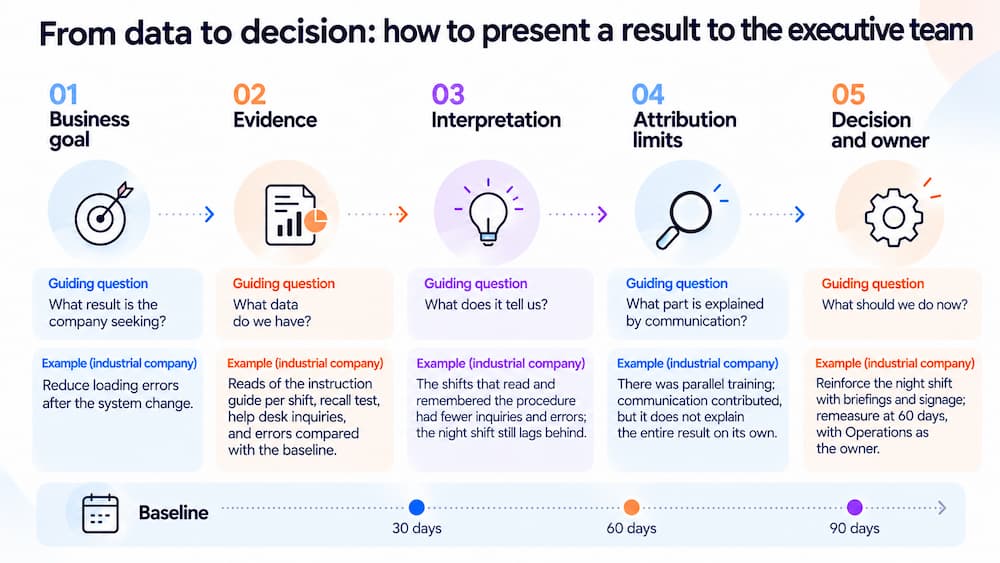
- Measure again at 30, 60, and 90 days. The real effect shows up over time.
Example: how to present a result to senior leadership
Illustrative case (not a client result): an industrial company launches a new order-loading procedure on the plant floor.
- Business goal: reduce loading errors after the system change.
- Evidence available: reads of the instruction guide per shift, a recall test on the three critical steps, support queries, and errors, compared with the baseline.
- Interpretation: the shifts that read and remembered the procedure have fewer queries and errors; the night shift, with less access to digital channels, is still lagging.
- Attribution limits: training sessions ran in parallel, so communication contributed to the result but doesn’t explain it on its own.
- Recommended decision: reinforce the night shift with supervisor briefings and signage, and measure again at 60 days, with Operations owning the indicator.
This way, leadership doesn't receive a reach report, but a decision backed by evidence.
The dashboard as a tool for leadership
A good internal communication dashboard doesn’t add more charts. It brings different sources together into a single reading:
- Agile pulse surveys. Three to five monthly questions about understanding, trust, and climate.
- Digital focus groups. Short sessions to understand the why behind the data.
- Platform analytics. Active users, reading time, and interaction, always segmented.
- Business indicators. Turnover, productivity, support queries, and progress of change projects.
However, bringing it all together isn’t free of obstacles. Data is often scattered across areas and tools. Also, many surveys lose honesty when they aren’t anonymous. That’s why it’s best to start with a few indicators and add sources gradually. At Oxean, we help unify them and reduce hierarchical bias in how they’re read.
A tip we apply in our projects:
Every dashboard indicator should have an owner and an associated decision. If a number doesn’t change any decision, it doesn’t belong on the dashboard.
And if you haven’t reviewed your channels yet, start with an internal communication audit.
Measure what matters
Demonstrating the value of internal communication takes more than open rates and clicks. Understanding, behavior change, climate, and business impact tell the whole story.
The challenge isn’t to measure more, but to measure what matters. This way, internal communication stops being seen as a cost and demonstrates its value.
At Oxean, as a corporate communication agency focused on internal and external communication, we help companies redesign their metrics. Through our strategic internal communication consulting, we turn isolated data into valuable decisions.