
Internal communication in Latin America works best when an organization keeps the same purpose and criteria in every country and defines what to adapt in each market: channel, tone, and timing.
For organizations operating in several countries across the region, that balance takes more work, because markets don’t get information, express themselves, or work the same way, even though most of them share a language.
In this article, we look at what the data says about those differences, what is worth adapting, and what should stay the same across the region.
Internal communication in Latin America: what the data says about employee engagement and message adaptation
Employee engagement varies from one country to another.
According to Gallup’s State of the Global Workplace 2026, 30% of employees in Latin America and the Caribbean are engaged in their work, compared with 20% globally. By country (three-year averages through 2025):The region starts from above-average engagement compared with the global figure, although there is an eight-point gap between Chile and countries such as Argentina, Colombia, or Peru.
Message relevance also plays a role.
According to The State of Workplace Communication study by Reworked and Korbyt, conducted with 1,175 U.S. employees, 59% say their trust in a message depends on how clear and specific it is.
That is why the underlying question in regional communication is what gets communicated the same way in every country and what gets adapted to each market.
What to adapt in internal communication for each Latin American market
The most visible differences fall into four areas: channels and access to information, language and tone, calendars and local context, and local leadership. Let’s look at each one.
Channels and access to information
According to a study by Staffbase and YouGov, conducted in Europe, the United States, and Australia, 48% of employees who work little or not at all at a computer feel their manager keeps them well informed, compared with 65% of those who work at a desk.That is why, before defining regional channels, it’s worth reviewing how each team accesses information, as we explain in our article on internal communication for frontline workers.
Language, tone, and local references
Brazil, for example, communicates in Portuguese and most other markets in Spanish, with vocabulary, expressions, and levels of formality that vary from country to country.
A message full of idioms from one market can feel foreign in another. That way, having local leads review the copy keeps the tone from creating distance.
Calendars, time zones, and local context
Holidays and time zones determine when it makes sense to, for example, launch a message or schedule a meeting. Each country’s context also shapes the topics that matter most to teams.
For that very reason, the regional calendar needs room for local adjustments.
Local leadership and middle managers
In each market, the leaders closest to teams are the ones who translate the regional message into their team’s reality. If they receive information late or without context, each of them may interpret it in their own way, and the message reaches people in different versions.
That is why key messages should reach them in advance, with room to adapt examples and tone.
What to keep consistent in internal communication across the region
Some elements give the organization coherence and are worth keeping in every market:
- Purpose and narrative: the company’s reason for being and the story it tells.
- Priorities and key messages: what every employee needs to understand, regardless of country.
- Governance criteria: owners, approval levels, and institutional tone.
- Comparable metrics: the same KPIs to evaluate each market.
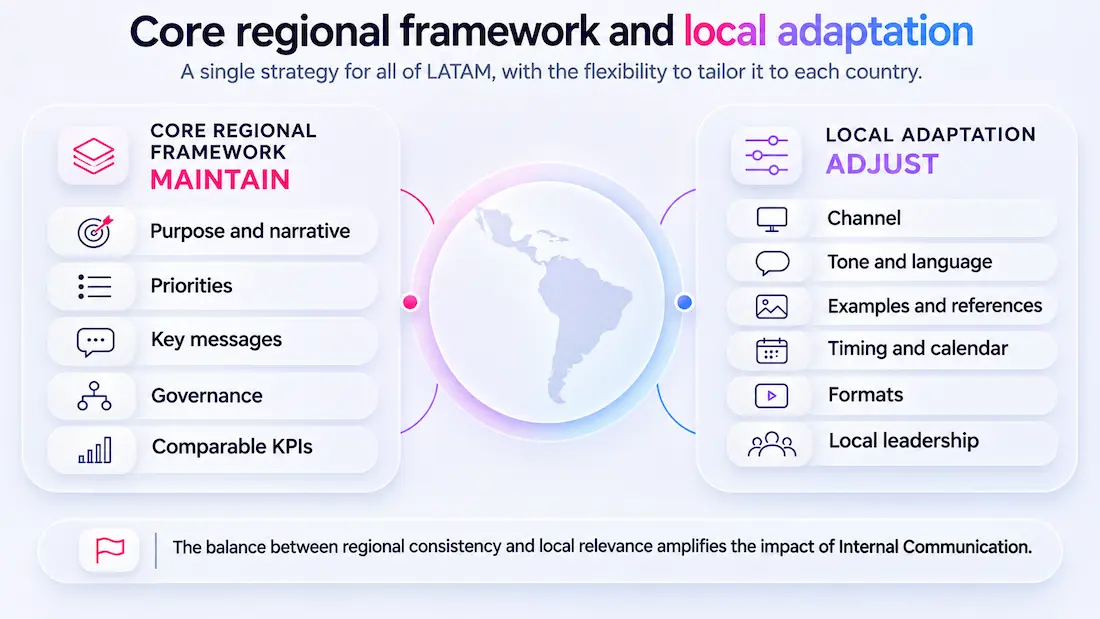
How to balance regional and local internal communication
The balance between regional and local comes from sharing decisions: the regional team defines the core and each market decides how to bring it to its own reality, with its own examples, tone, channels, and schedules, always validated by a local lead.
Then every country is measured with the same metrics, which makes it possible to compare results and adjust based on data.That way, each country communicates in its own style and the whole organization keeps one message.
Local assessment: how to know what to adapt in each country
To know what to adapt in each country, the starting point is a local internal communication assessment:
- Which audiences exist
- Which channels they use
- How they currently perceive the organization’s communication
With that information, adaptations respond to each team’s verified needs.
Checklist before adapting a message for a local market
Before adapting a message for a market, it’s worth confirming three points:
- The core message is the same in every country.
- A local lead validated the tone, examples, and channel.
- Results can be compared with those of other markets.
If all three are met, adaptation adds value without fragmenting the message.
Internal communication in Latin America: consistency with local adaptation
Keeping the core and adapting the form is the logic behind all regional internal communication: what is shared brings consistency and what is local brings relevance.
However, that balance only holds when the core is clearly defined and adaptation is validated with the people who know each country. That way, the region gains consistency without losing closeness with each team.
In short, communicating in Latin America means deciding what to keep and what to adapt, and reviewing that decision with data from each market.
At Oxean, as a corporate communication agency focused on internal and external communication, we support organizations with a presence in several Latin American countries in designing strategies that keep a shared core and adapt to each market.