
An internal communication assessment shows when your internal communication strategy needs a review, even if there are no obvious problems. It reveals what is being communicated, who it reaches, what people understand, and which decisions are still being made on gut feeling.
These five signs can help you recognize when it makes sense to review your internal communication strategy with evidence before the gaps become more visible.
When should you review your internal communication strategy?
You don’t need to wait for something to break. It’s also worth reviewing your strategy when the organization changes or when it’s no longer clear whether communication still meets the real needs of its audiences.
Some early signs are:
- decisions are based on intuition rather than data;
- no one has reviewed the strategy in a while;
- new audiences, locations, or channels are being added;
- business or communication priorities are shifting.
If any of these situations keeps coming up in your organization, it’s a good time to check what’s working, what has lost effectiveness, and what needs adjusting.
What does the data show about strategy and measurement?
The problem isn’t always a lack of data, but what gets measured and what happens with that information afterward.
According to Gallagher’s Employee Communications Report 2026, 70% of teams mainly measure output metrics, such as views or clicks, while only 16% measure outcomes, such as employee sentiment.
The same study notes that 73% want Internal Communication to act as a strategic consultant to the business, but only 18% say they do so regularly.
Meanwhile, research by Interact and Ragan Communications found that 71% of communicators collect data, but only 11% use it to guide decisions.
The gap is clear: measuring isn’t enough. A strategy needs information that helps you understand audiences, behaviors, and results, and that can then be turned into decisions.
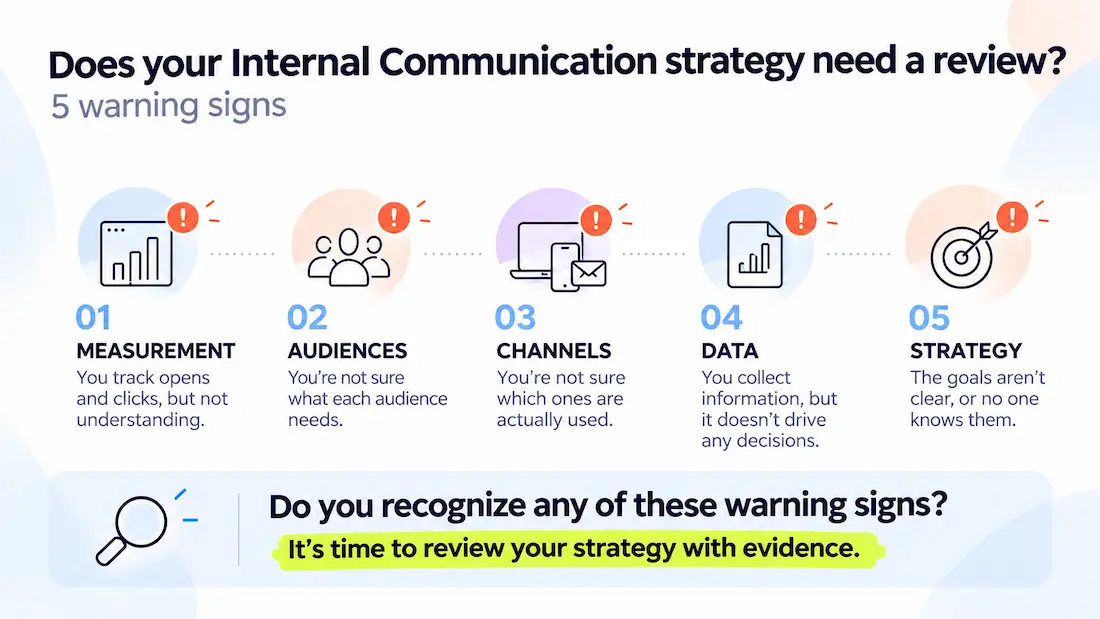
5 signs your internal communication strategy needs a review
1. You measure what you send, but not what your employees understand
Opens, views, and clicks help you understand reach, but they don’t prove that a message was understood.
A message can have an excellent open rate and still leave doubts about what’s changing or what’s expected of each person.
Ask yourself:
- Do you know how many people understood your last key message?
- Do you measure any action that follows the communication?
- Do your reports show what changed after the message?
If the answer is usually no, you’re only measuring part of the journey.
An assessment lets you add indicators of understanding, perception, and action.
2. You don't know what each audience needs
Not everyone receives or consumes information the same way. Role, location, access to devices, and available time all shape the communication experience.
The Staffbase and YouGov study shows, for example, that 48% of non-desk employees say they feel well or very well informed by their manager, compared with 65% of those who mainly work at a computer.
When those differences are overlooked, the same message ends up going through the same channels to audiences with different needs.
Reviewing your audiences helps you spot gaps and adjust content, segmentation, and channels to each reality.
3. You don't know which channels are actually used
Email, intranet, chat, bulletin boards, apps, and meetings can all coexist in one organization. The problem arises when the channel map is designed around what the team believes happens rather than around actual use.
Try a simple test:
- Pick your last important announcement.
- Ask different groups which channel they heard about it through.
- Compare their answers with the channels the communication team used.
If the real paths don’t match what you expected, it’s worth reviewing the channel ecosystem before adding a new tool.
If the problem lies specifically in channel overload, adoption, or purpose, an internal communication audit lets you take that analysis further.
4. You collect data, but don't use it to make decisions
Surveys, analytics, and reports generate information. But piling up data doesn’t improve communication on its own.
Some warning signs are:
- survey results aren’t shared;
- reports don’t change plans;
- no one can point to a decision made based on a specific data point.
Every finding should answer a question or help make a decision. If nothing changes, measurement becomes a box-checking exercise.
5. The strategy isn't defined or nobody knows it
A strategy works when the people who communicate and the people who make decisions share a direction.
If the goals aren’t clear outside the Internal Communication team, day-to-day work tends to be driven by urgent requests and one-off actions.
Here’s a simple test: ask leaders from three departments to explain the main goals of internal communication.
If the answers vary widely, the strategy probably isn’t truly shared yet.
Reviewing it helps you reset priorities and move from responding to requests to communicating with a common purpose.
What should you do when you spot these signs?
- Define what you need to know. It could be what people understand, which channels they use, or how certain messages are perceived.
- Gather information. Combine surveys, interviews, and a review of channels and recent communications.
- Cross-check findings with indicators. As we explain in our article on internal communication metrics, it’s worth looking at understanding and behavior, not just reach.
- Prioritize and adjust. Rank findings by their impact and the effort needed to address them.
From assessment to an evidence-based strategy
When you don’t measure, segment, or ask, many decisions end up being made on intuition.
An assessment isn’t meant to solve everything at once. Its value lies in organizing information, identifying the most relevant gaps, and deciding where to start.
Reviewing your strategy regularly lets you check whether communication still meets the real needs of the organization and its audiences.
At Oxean, we help organizations assess their current situation and define an internal communication strategy with clear goals, combining assessment, strategy, implementation, and measurement.